✈️ Aircraft Specifications
| Designation | Yak-28 |
| Manufacturer | Yakovlev |
| Country of Origin | Soviet Union |
| First Flight | 1958 |
| Length | 21.65 m (71 ft) |
| Max Speed (Mach) | 1.1 |
| Max Speed (km/h) | 1,840 km/h |
| Service Ceiling | 16,000 m (52,496 ft) |
| Range | 2,395 km (1,487 mi) |
| Engine | 2× Tumansky R-11 turbojet |
| Crew | 2 |
| Status | Retired |
Overview
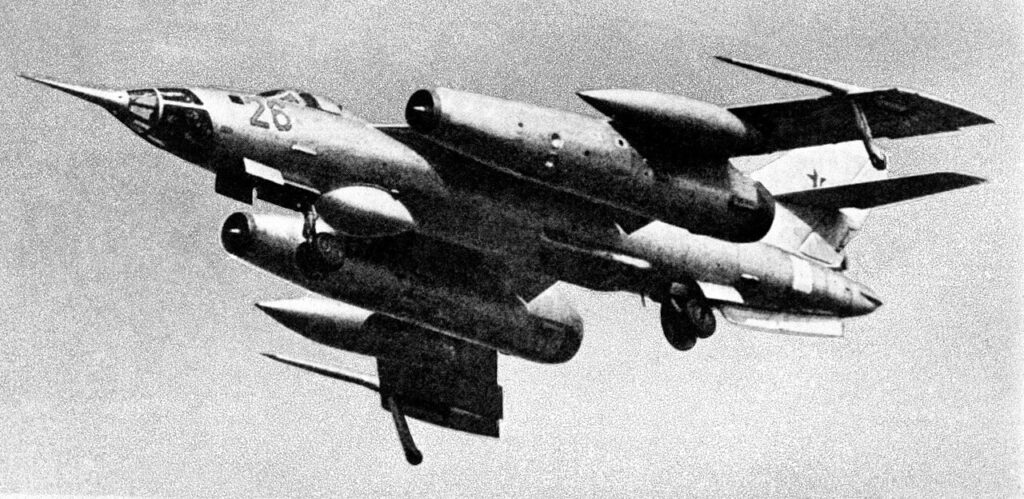
The Yakovlev Yak-28 (NATO reporting name “Brewer”) is a swept-wing, twin-engine combat aircraft that served the Soviet Union in multiple roles from the early 1960s through the dissolution of the USSR. Initially designed as a tactical medium bomber, the Yak-28 was adapted into reconnaissance, electronic warfare, interceptor, and trainer variants — earning separate NATO codenames including Brewer, Firebar, and Maestro. With 1,180 aircraft produced, the Yak-28 was one of the most versatile Soviet combat platforms of the Cold War era.
Design & Development
Based on the Yak-129 prototype that first flew on 5 March 1958, the Yak-28 featured a large mid-mounted wing swept at 45 degrees. Two Tumansky R-11 turbojet engines, each producing 57 kN (12,795 lbf) of thrust, were mounted in underwing pods similar to the earlier Yak-25. The aircraft utilized a bicycle-type main landing gear supplemented by outrigger wheels near the wingtips, leaving most of the fuselage available for fuel and mission equipment.
The Yak-28 was primarily subsonic, though it could exceed Mach 1 at high altitude. The tailplane was set halfway up the vertical fin, and the wings featured leading-edge slats and trailing-edge slotted flaps. Western analysts first observed the aircraft at the 1961 Tushino air show, initially misidentifying it as a fighter designated “Flashlight” before its true bomber role was recognized and the NATO name “Brewer” was assigned.
Operational History
The Yak-28 entered service in 1964 with Soviet Air Forces and Air Defence Forces. The aircraft is perhaps best remembered for the heroic actions of Captain Boris Kapustin and Lieutenant Yuri Yanov on 6 April 1966. After suffering a catastrophic engine malfunction over East Germany, the crew steered their stricken Yak-28 away from a West Berlin housing estate and crashed into Lake Stößensee without ejecting. Both pilots were posthumously awarded the Order of the Red Banner.
The interceptor variant (Yak-28P) was withdrawn in the early 1980s, while trainer and ECM versions continued flying until at least 1992. The reconnaissance and electronic warfare aircraft were eventually replaced by variants of the Sukhoi Su-24. Total production across all variants reached 1,180 airframes.
Capabilities
- Maximum Speed: Mach 1.1 (~1,840 km/h) at altitude
- Service Ceiling: 16,000 m (52,500 ft)
- Range: 2,395 km (1,488 mi)
- Multi-Role Platform: Bomber, reconnaissance, ECM, interceptor, and trainer variants
- Crew: 2 (pilot and navigator/weapons officer)
- Engines: 2× Tumansky R-11 afterburning turbojets
Armament & Weapons
- Bomber variant (Yak-28B/L): Internal bomb bay for free-fall nuclear or conventional bombs up to 3,000 kg
- Interceptor variant (Yak-28P): 2× R-8M air-to-air missiles (semi-active radar and infrared homing variants)
- No internal cannon on standard production versions
Video
Frequently Asked Questions
What was the Yak-28 used for?
The Yak-28 served in multiple roles including tactical bombing, aerial reconnaissance, electronic warfare jamming, air defense interception, and crew training. Its versatile airframe made it one of the most adaptable Soviet combat platforms of the 1960s–1980s.
How many Yak-28s were built?
A total of 1,180 Yak-28 aircraft were produced across all variants, making it a significant production run for a Soviet combat aircraft of its era.
When was the Yak-28 retired?
The interceptor variant was withdrawn in the early 1980s. Other versions continued in service until the fall of the Soviet Union, with the last examples flying until at least 1992 in Belarus.
What is the famous Yak-28 incident in West Berlin?
On 6 April 1966, pilots Kapustin and Yanov deliberately crashed their malfunctioning Yak-28 into a West Berlin lake rather than eject over a populated area. They were posthumously honored by both Soviet and British military forces.