✈️ Aircraft Specifications
| Designation | JH-7 / FBC-1 |
| Manufacturer | Xi'an Aircraft Industry Corporation |
| Country of Origin | China |
| First Flight | 1988 |
| Length | 22.3 m (73.2 ft) |
| Max Speed (Mach) | 1.75 |
| Max Speed (km/h) | 1,808 km/h |
| Service Ceiling | 15,500 m (50,856 ft) |
| Range | 3,650 km (2,267 mi) |
| Engine | 2x Xian WS-9 (Rolls-Royce Spey derivative) turbofan |
| Crew | 2 |
| Status | Active |
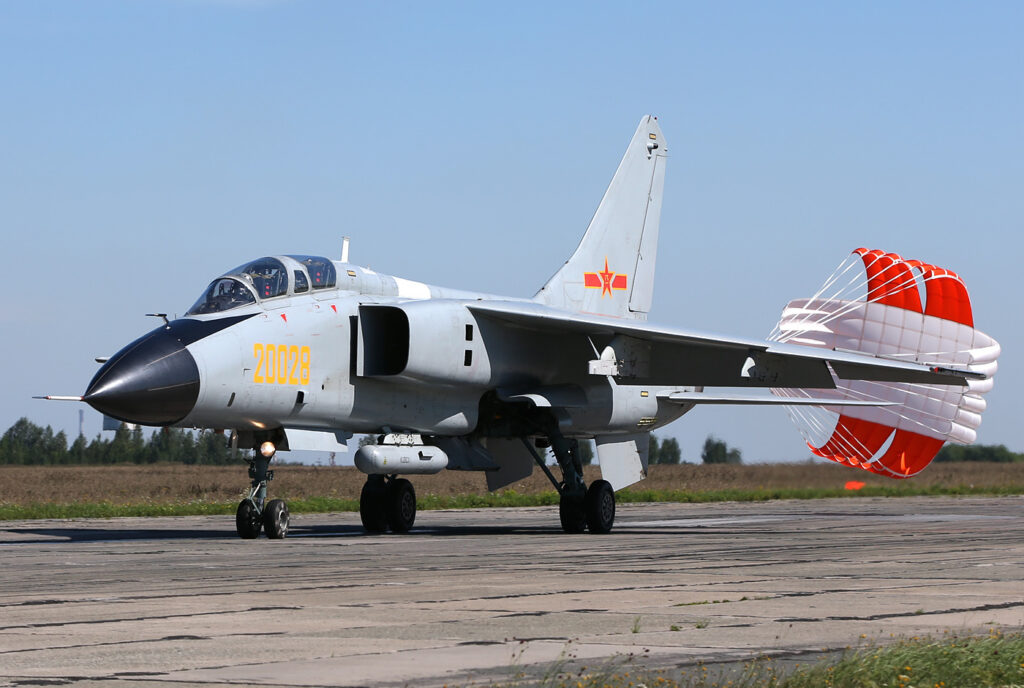
Overview
The Xi’an JH-7, also known as the FBC-1 Flying Leopard (NATO reporting name: Flounder), is a Chinese tandem two-seat, twin-engine fighter-bomber and strike aircraft. Produced by Xi’an Aircraft Industrial Corporation, approximately 270 aircraft were built between 1988 and 2017. The JH-7 serves with both the PLA Naval Air Force and PLA Air Force, fulfilling maritime strike, close air support, and tactical bombing roles.
Design & Development
Development began in the early 1970s as a replacement for the Nanchang Q-5. Xi’an’s proposal was for a large two-seat aircraft comparable to the F-111 Aardvark and Panavia Tornado. The Falklands War renewed interest in a naval fighter-bomber, and in November 1982 the JH-7 became the main focus of development.
The aircraft is powered by license-produced Rolls-Royce Spey Mk 202 turbofans, designated WS-9. Five prototypes were built, with the first flight occurring on 14 December 1988 — though it ended in an emergency landing due to vibration. The improved JH-7A featured a lighter, stronger airframe capable of carrying 9,000 kg of ordnance, double the capability of the original, along with precision strike avionics and helmet-mounted sight.
Operational History
The JH-7 entered PLANAF service in 1994 with pre-production aircraft, receiving its type certificate in 1998. The improved JH-7A entered PLAAF service in 2004. Full production was delayed by problems with the WS-9 engine program, prompting the PLAAF to order Su-30MKK fighters as an interim solution.
The JH-7 has been a regular participant in Chinese military exercises and international competitions, demonstrating its precision strike and maritime attack capabilities. It has gradually been supplemented by the more capable J-16 in frontline units.
Capabilities
- Maximum speed of Mach 1.75 (1,808 km/h) suitable for high-speed maritime strike
- 3,650 km range for extended maritime patrol and deep strike missions
- 9,000 kg ordnance capacity (JH-7A) on 11 hardpoints
- Anti-ship missile capability with up to four YJ-81/YJ-83 missiles
- Fly-by-wire flight control system for enhanced handling
- Helmet-mounted sight for rapid target acquisition
Armament & Weapons
- Gun: 1× 23mm twin-barrel cannon
- Anti-ship missiles: YJ-81, YJ-83, YJ-12
- Air-to-air missiles: PL-5, PL-8, PL-12
- Air-to-ground missiles: KD-88
- Guided bombs: LS-500J laser-guided, satellite-guided munitions
- Anti-radiation missiles for SEAD operations
- Unguided rockets and bombs up to 500 kg class
Video
Frequently Asked Questions
Why is the JH-7 called the Flying Leopard?
The export designation FBC-1 stands for “Fighter/Bomber China-1,” while the nickname “Flying Leopard” (飞豹) was given to reflect the aircraft’s speed and aggressive strike capability. The name became well-known internationally through export marketing efforts.
What engines does the JH-7 use?
The JH-7 is powered by two WS-9 turbofan engines, which are Chinese license-produced versions of the Rolls-Royce RB.168 Spey Mk 202. The engine program experienced significant delays, with Rolls-Royce assisting in production during 1997-1998.
Is the JH-7 still in service?
Yes, the JH-7A remains operational with both the PLAAF and PLANAF as of 2025, though production ended in 2017. The aircraft is gradually being supplemented by the more capable Shenyang J-16 in many units.