✈️ Aircraft Specifications
| Designation | Tu-22M3 |
| Manufacturer | Tupolev |
| Country of Origin | Soviet Union |
| First Flight | 1969 |
| Length | 41.46 m (136 ft) |
| Max Speed (Mach) | 1.88 |
| Max Speed (km/h) | 2,300 km/h |
| Service Ceiling | 13,300 m (43,637 ft) |
| Range | 2,410 km (1,497 mi) |
| Engine | 2x Kuznetsov NK-25 afterburning turbofans |
| Crew | 4 |
| Status | Active |
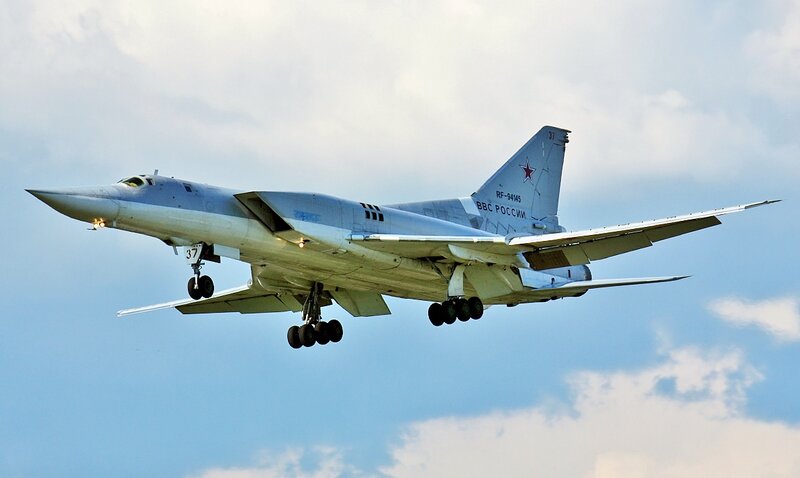
Overview
The Tupolev Tu-22M (NATO reporting name: Backfire) is a Soviet supersonic, variable-sweep wing, long-range strategic and maritime strike bomber that has been a cornerstone of Russian military aviation since the early 1970s. First flying on 30 August 1969, the Tu-22M was developed as a replacement for the problematic Tupolev Tu-22 and served in both strategic bombing and anti-shipping roles during the Cold War. A total of 497 Tu-22Ms were built between 1967 and 1993. The bomber remains in active service with the Russian Aerospace Forces and has seen combat in Afghanistan, Chechnya, Georgia, Syria, and Ukraine.
Design & Development
By 1962, it was clear that the original Tu-22 was inadequate as a bomber, suffering from widespread maintenance problems, dangerous handling characteristics, and a landing speed 100 km/h faster than previous bombers. Tupolev began work on a major update incorporating variable-sweep wings and uprated engines. To secure government approval and deflect criticism about replacing such a recently introduced aircraft, Tupolev and the Soviet Air Force agreed to pass off the entirely new design as merely an “update” — hence the Tu-22M designation rather than a new number.
The swing-wing design, designated Samolyot 145, borrowed from the Tu-22’s weapon system and Kh-22 missile while incorporating lessons from the Tu-98 project. The government approved development on 28 November 1967. The initial Tu-22M0 prototypes led to the improved Tu-22M2 and the definitive Tu-22M3 with redesigned air intakes and more powerful NK-25 engines. U.S. intelligence first detected the aircraft in 1969 via satellite, surprising Western analysts who believed Soviet leadership had abandoned manned bombers in favor of ICBMs.
The Tu-22M’s variable-sweep wings provided the ideal combination of short takeoff performance, efficient cruising, and good high-speed low-level penetration capability. The Tu-22M became a major concern during SALT/START arms control negotiations, with its strategic capability being a contentious point between the superpowers.
Operational History
The Tu-22M was first used in combat during the Soviet-Afghan War, conducting conventional bombing missions. Russian Tu-22Ms have since seen action in the First Chechen War, the 2008 Russo-Georgian War, Russia’s intervention in the Syrian Civil War, and extensively in the ongoing Russo-Ukrainian War. In the Ukraine conflict, Tu-22M3s have launched cruise missiles and conducted bombing raids, though the fleet has suffered losses including a dramatic Ukrainian drone attack in June 2025 (Operation Spiderweb) that destroyed four Tu-22Ms at Belaya air base.
During the Cold War, Soviet Tu-22Ms regularly patrolled and conducted simulated attacks over the Baltic Sea and occasionally the North Pacific, frequently being intercepted by NATO fighters. The aircraft was forward-deployed to Turkmenistan, Syria, and Iran at various times. Under the Nunn-Lugar Cooperative Threat Reduction program, the 60 Tu-22Ms inherited by Ukraine after the Soviet dissolution were dismantled by 2006. As of 2024, Russia reportedly has 57 aircraft in service, though Ukrainian intelligence estimated only 27 were operable in 2023.
Capabilities
- Maximum Speed: Mach 1.88 (2,300 km/h / 1,430 mph) at altitude
- Service Ceiling: 13,300 meters (43,600 feet)
- Combat Range: 2,410 km (1,500 miles); ferry range 7,000 km
- Payload: Up to 24,000 kg (53,000 lb) of ordnance
- Engines: 2 × Kuznetsov NK-25 afterburning turbofans, 245.2 kN each with afterburner (Tu-22M3)
- Variable-Sweep Wings: Adjustable from 20° to 65° for optimized performance across all flight regimes
- Crew: 4 (pilot, co-pilot, navigator, weapons systems officer)
- Maritime Strike: Capable of carrying and launching long-range anti-ship missiles
Armament & Weapons
- Cannon: 1 × GSh-23 twin-barrel 23 mm cannon in tail turret (Tu-22M3)
- Anti-Ship Missiles: Up to 3 × Kh-22 (AS-4 Kitchen) or 10 × Kh-15 (AS-16 Kickback) on rotary launcher
- Cruise Missiles: Kh-32 upgraded anti-ship missiles on modernized Tu-22M3M variants
- Conventional Bombs: Up to 24,000 kg of FAB-250, FAB-500, FAB-1500, or FAB-3000 bombs
- Nuclear Weapons: Nuclear-tipped Kh-22 or Kh-15 missiles, or nuclear gravity bombs
- Mines: Various naval mines for anti-shipping mine-laying operations
Video
Frequently Asked Questions
What is the relationship between the Tu-22 and the Tu-22M?
Despite sharing the Tu-22 designation, the Tu-22M is essentially a completely different aircraft from the original Tu-22 “Blinder.” The “M” designation was a deliberate bureaucratic maneuver — Tupolev and the Soviet Air Force presented the entirely new swing-wing design as merely a “modification” of the Tu-22 to secure government approval more easily and avoid embarrassment over the Tu-22’s operational deficiencies.
Why was the Tu-22M controversial in arms control negotiations?
The Tu-22M’s strategic capability was a major point of contention during SALT and START negotiations. The United States argued it was a strategic bomber capable of reaching U.S. territory with aerial refueling, while the Soviet Union classified it as a medium-range “theater” bomber. The Soviets agreed to remove the aerial refueling probes from production aircraft as a compromise, though this was later reversed.
Is the Tu-22M still operational today?
Yes, the Tu-22M3 remains in service with the Russian Aerospace Forces, though in reduced numbers. As of 2024, approximately 57 aircraft were reported in service, though operational readiness may be lower. The fleet has been actively used in the Russo-Ukrainian conflict and has suffered combat losses. Russia has been working on the Tu-22M3M modernization program to extend the type’s service life with updated avionics and new weapons capabilities.
How has the Tu-22M performed in recent conflicts?
In Syria, Tu-22M3s conducted conventional bombing missions against opposition targets. In the Ukraine conflict, they have been used to launch cruise missiles and conduct bombing raids, though the fleet has suffered significant losses including ground attacks on airbases. The June 2025 Operation Spiderweb drone attack by Ukraine destroyed four Tu-22Ms at Belaya air base, highlighting the vulnerability of these high-value assets.
References & Sources
- Wikipedia – Tupolev Tu-22M
- Gordon, Yefim. Tupolev Tu-22M: Famous Russian Aircraft. Midland Publishing, 2006.
- International Institute for Strategic Studies – The Military Balance 2024