✈️ Aircraft Specifications
| Designation | Tu-22 |
| Manufacturer | Tupolev |
| Country of Origin | Soviet Union |
| First Flight | 1959 |
| Length | 41.6 m (136.5 ft) |
| Max Speed (Mach) | 1.52 |
| Max Speed (km/h) | 1,640 km/h |
| Service Ceiling | 13,300 m (43,637 ft) |
| Range | 5,100 km (3,167 mi) |
| Engine | 2× Dobrynin RD-7M-2 afterburning turbojet |
| Crew | 3 |
| Status | Retired |
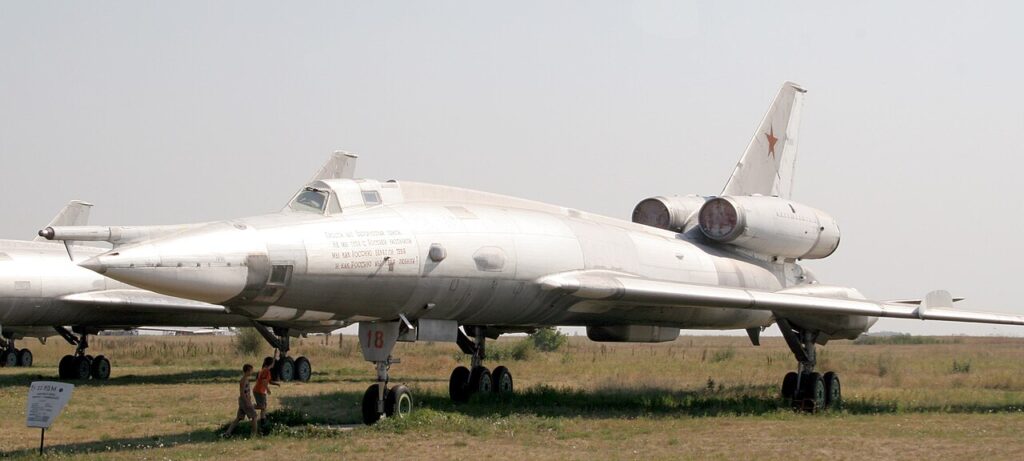
Overview
The Tupolev Tu-22 (NATO reporting name “Blinder”) was the first supersonic bomber to enter production in the Soviet Union. Entering service in 1962 with Long-Range Aviation and Soviet Naval Aviation, the Tu-22 was manufactured in several variants including bomber, reconnaissance, and missile carrier configurations. While the aircraft was considered a disappointment in terms of performance, 311 were built and it saw combat service with export operators including Libya and Iraq.
Design & Development
Development of the Tu-22 began in the mid-1950s when Tupolev’s OKB-156 sought to create a supersonic replacement for the Tu-16 medium bomber. Chief designer Sergey Yeger led the effort, eventually settling on the revolutionary “Samolyot 105” design in 1954. The aircraft featured a highly swept wing (52–55°) and an unconventional engine placement with two Dobrynin RD-7M-2 afterburning turbojets mounted on either side of the vertical stabilizer at the tail.
The tail-mounted engine configuration reduced drag and inlet losses but created significant maintenance challenges. The highly swept wings gave low transonic drag but resulted in poor takeoff performance and dangerously high landing speeds. A single pilot operated the aircraft without a copilot, allowing a narrower cockpit. The first prototype flew on 21 June 1958, but testing revealed the design fell short of both speed and range targets.
Operational History
The Tu-22 entered service in 1962 but quickly gained a reputation as a difficult aircraft to fly and maintain. Its high landing speed and demanding handling characteristics led to numerous accidents. Despite these issues, the aircraft served in multiple roles — the Tu-22R reconnaissance variant and the Tu-22K missile carrier armed with the Kh-22 anti-ship missile proved particularly valuable.
Export Tu-22s saw combat in several conflicts: Libyan Tu-22s bombed targets during the Uganda–Tanzania War and the Chadian–Libyan conflict, while Iraqi Tu-22s conducted bombing missions during the Iran–Iraq War. The type was retired from Russian service in the 1990s, with Libya being the last operator into the early 2000s.
Capabilities
- Maximum Speed: Mach 1.52 (~1,640 km/h) at altitude
- Service Ceiling: 13,300 m (43,635 ft)
- Range: 5,100 km (3,170 mi)
- First Supersonic Soviet Bomber: Pioneering design entering production in 1960
- Crew: 3 (pilot, navigator, weapons operator)
- Engines: 2× Dobrynin RD-7M-2 afterburning turbojets
Armament & Weapons
- Defensive Gun: 1× R-23 23mm cannon in tail turret
- Internal Bomb Bay: Up to 9,000 kg of free-fall bombs (conventional or nuclear)
- Missile Carrier (Tu-22K): 1× Kh-22 (AS-4 Kitchen) long-range anti-ship missile
- Nuclear Capability: Designed to deliver nuclear weapons
Video
Frequently Asked Questions
Was the Tu-22 successful?
The Tu-22 was generally considered a disappointment, failing to meet its designed speed and range goals. It was difficult to fly and maintain, and was produced in relatively small numbers (311) compared to its predecessor the Tu-16.
Did the Tu-22 see combat?
Yes. Export Tu-22s operated by Libya saw combat in the Uganda–Tanzania War and conflicts in Chad, while Iraqi Tu-22s flew bombing missions during the Iran–Iraq War.
What replaced the Tu-22?
The Tu-22 was eventually succeeded by the Tupolev Tu-22M “Backfire,” a completely different variable-geometry wing bomber that shares only the designation number. The Su-24 also replaced it in tactical roles.