✈️ Aircraft Specifications
| Designation | Tu-128 |
| Manufacturer | Tupolev |
| Country of Origin | Soviet Union |
| First Flight | 1961 |
| Length | 30.06 m (98.6 ft) |
| Max Speed (Mach) | 1.65 |
| Max Speed (km/h) | 1,765 km/h |
| Service Ceiling | 15,600 m (51,184 ft) |
| Range | 2,565 km (1,593 mi) |
| Engine | 2× Lyulka AL-7F-2 afterburning turbojet |
| Crew | 2 |
| Status | Retired |
Overview
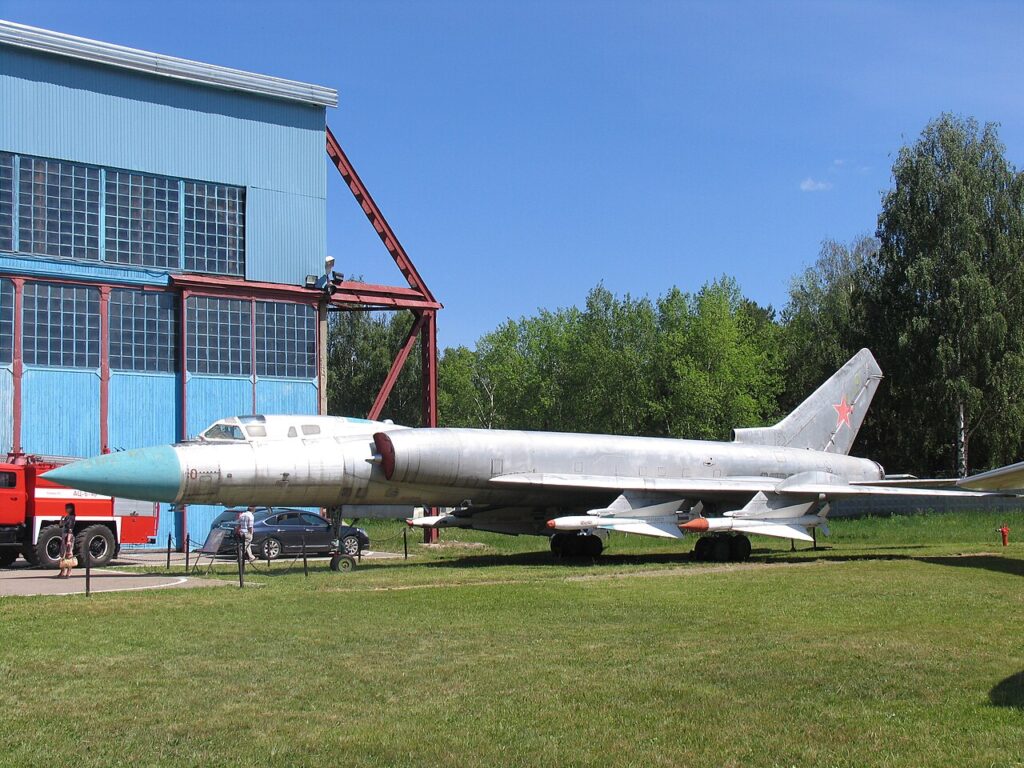
The Tupolev Tu-128 (NATO reporting name “Fiddler”) holds the distinction of being the largest and heaviest fighter aircraft ever to enter serial production. Weighing up to 43 tonnes at maximum takeoff weight, this massive long-range interceptor was designed to defend the vast and sparsely defended northern borders of the Soviet Union against NATO nuclear bombers. With 198 aircraft built, the Tu-128 served the Soviet Air Defence Forces (PVO) from 1964 until 1990.
Design & Development
Development of the Tu-128 began in 1958 under Iosif Nezval at the Tupolev Design Bureau, based on the unsuccessful Tu-98 supersonic bomber prototype. The Soviet PVO needed a long-range interceptor capable of covering vast stretches of Arctic frontier from widely spaced airbases — a mission that smaller interceptors like the Yak-28P could not fulfill economically.
The Tu-128 featured a broad, low/mid-mounted swept wing with main landing gear in wing-mounted pods. Two Lyulka AL-7F-2 turbojet engines were mounted in the fuselage, and the two-man crew of pilot and navigator sat in tandem. The aircraft carried a RP-S Smerch radar with a detection range of approximately 50 km and lock-on range of 40 km. As a pure interceptor with high wing loading, it was not agile and was intended solely to engage large NATO bombers like the B-52, not to dogfight smaller aircraft.
Operational History
The Tu-128 made its initial public appearance at the 1961 Tushino air parade, where Western experts mistakenly believed a belly-mounted instrument bulge indicated an AWACS role. The type entered operational service in 1964, deployed across the vast northern and eastern regions of the Soviet Union.
The Tu-128’s only publicly known combat actions were the destruction of NATO reconnaissance balloons. Through the 1980s, Tu-128 units progressively converted to the more capable Mikoyan MiG-31, with the last Tu-128s retiring by 1990. Production ended in 1970 after 198 aircraft were completed.
Capabilities
- Maximum Speed: Mach 1.65 (~1,765 km/h) at altitude
- Service Ceiling: 15,600 m (51,180 ft)
- Range: 2,565 km (1,594 mi)
- Heaviest Fighter Ever Produced: Maximum weight of 43 tonnes
- Radar: RP-S Smerch with 50 km detection range
- Engines: 2× Lyulka AL-7F-2 afterburning turbojets
Armament & Weapons
- Primary Armament: 4× Bisnovat R-4 (AA-5 Ash) air-to-air missiles
- Missile Configuration: 2× R-4R semi-active radar homing (outer pylons) + 2× R-4T infrared homing (inner pylons)
- No internal gun or bomb bay — pure missile-armed interceptor
Video
Frequently Asked Questions
Why was the Tu-128 so large?
The Tu-128 needed enormous fuel tanks to provide the long range and patrol endurance required to cover the Soviet Union’s vast northern borders from widely spaced airbases. Its size also allowed it to carry the large R-4 missiles needed to engage bombers at long range.
Could the Tu-128 dogfight?
No. The Tu-128 was a pure interceptor with high wing loading and poor maneuverability. It was designed exclusively to engage large NATO bombers like the B-52 using long-range missiles, not to engage in close combat with fighters.
What replaced the Tu-128?
The Tu-128 was replaced by the Mikoyan MiG-31 “Foxhound,” which offered far superior speed, radar capability, and weapons while maintaining the long-range interceptor mission profile.