✈️ Aircraft Specifications
| Designation | Su-11 |
| Manufacturer | Sukhoi |
| Country of Origin | Soviet Union |
| First Flight | 1958 |
| Length | 18.39 m (60.3 ft) |
| Max Speed (Mach) | 2.2 |
| Max Speed (km/h) | 2,340 km/h |
| Service Ceiling | 17,000 m (55,777 ft) |
| Range | 1,400 km (869 mi) |
| Engine | 1× Lyulka AL-7F-1 afterburning turbojet |
| Crew | 1 |
| Status | Retired |
Overview
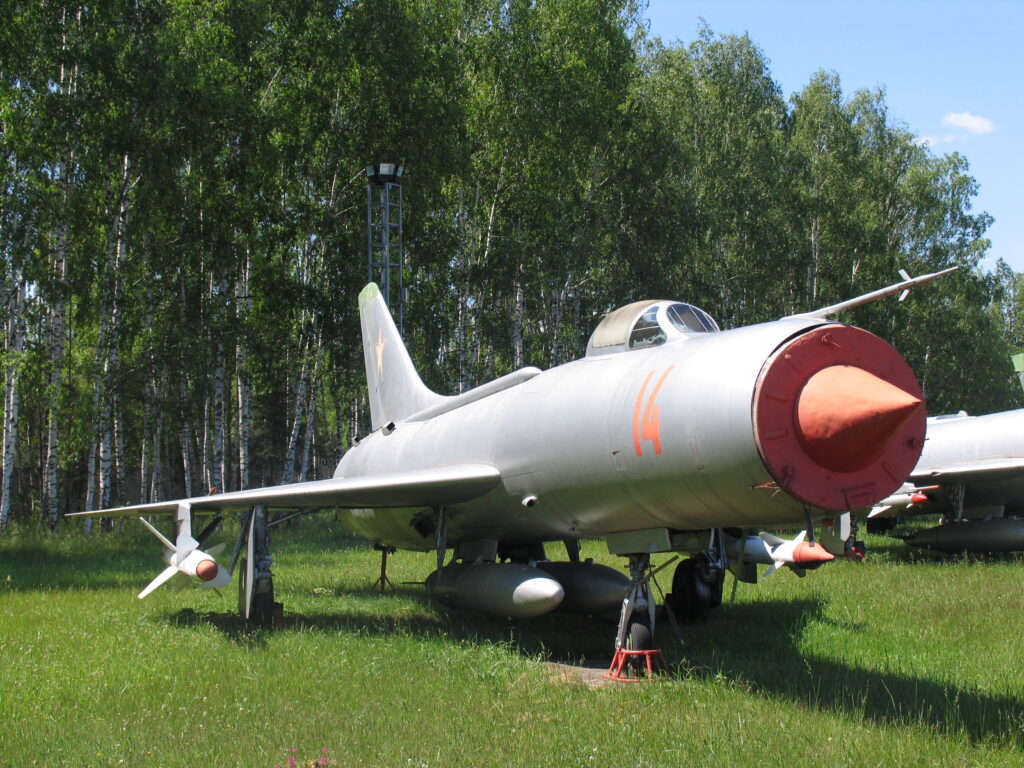
The Sukhoi Su-11 (NATO: Fishpot-C) was an improved version of the Su-9 interceptor with a larger radar and more capable missiles. It served in the Soviet Air Defense Forces (PVO) through the 1970s.
Design & Development
The Su-11 retained the Su-9’s basic delta-wing layout but featured a larger nose cone housing the Oryol-D radar, which provided better range and tracking. The new radar enabled the use of the improved K-8 (AA-3 Anab) missiles, which came in both semi-active radar and infrared variants.
Operational History
The Su-11 entered service in 1964 as a stopgap while the more advanced Su-15 was being developed. Only about 108 were built — far fewer than the Su-9 — as the Su-15 was already in development. The Su-11 was never exported and remained exclusively in Soviet service until retirement in the 1980s.
Capabilities
- Improved Oryol-D radar over Su-9
- K-8 missile capability (radar + IR)
- Mach 1.8 top speed
- All-weather interception
- Ground-controlled interception (GCI)
Armament & Weapons
- 2× K-8 (AA-3 Anab) missiles (1× radar-guided + 1× IR-guided)
- No internal gun
Video
Frequently Asked Questions
How was the Su-11 different from the Su-9?
The Su-11 had a larger radar (Oryol-D) and used the more capable K-8 missile system instead of the Su-9’s K-5 missiles.
How many Su-11s were built?
Only about 108 Su-11s were produced — a small number compared to the 1,100 Su-9s.
Why were so few built?
The Su-11 was a stopgap design; the much more capable Su-15 Flagon was already in development and entered service soon after.