✈️ Aircraft Specifications
| Designation | Jaguar |
| Manufacturer | SEPECAT (Breguet/BAC) |
| Country of Origin | France / United Kingdom |
| First Flight | 1968 |
| Length | 16.83 m (55.2 ft) |
| Max Speed (Mach) | 1.6 |
| Max Speed (km/h) | 1,700 km/h |
| Service Ceiling | 14,000 m (45,934 ft) |
| Range | 1,600 km (994 mi) |
| Engine | 2x Rolls-Royce Turbomeca Adour afterburning turbofan |
| Crew | 1 |
| Status | Active |
Overview
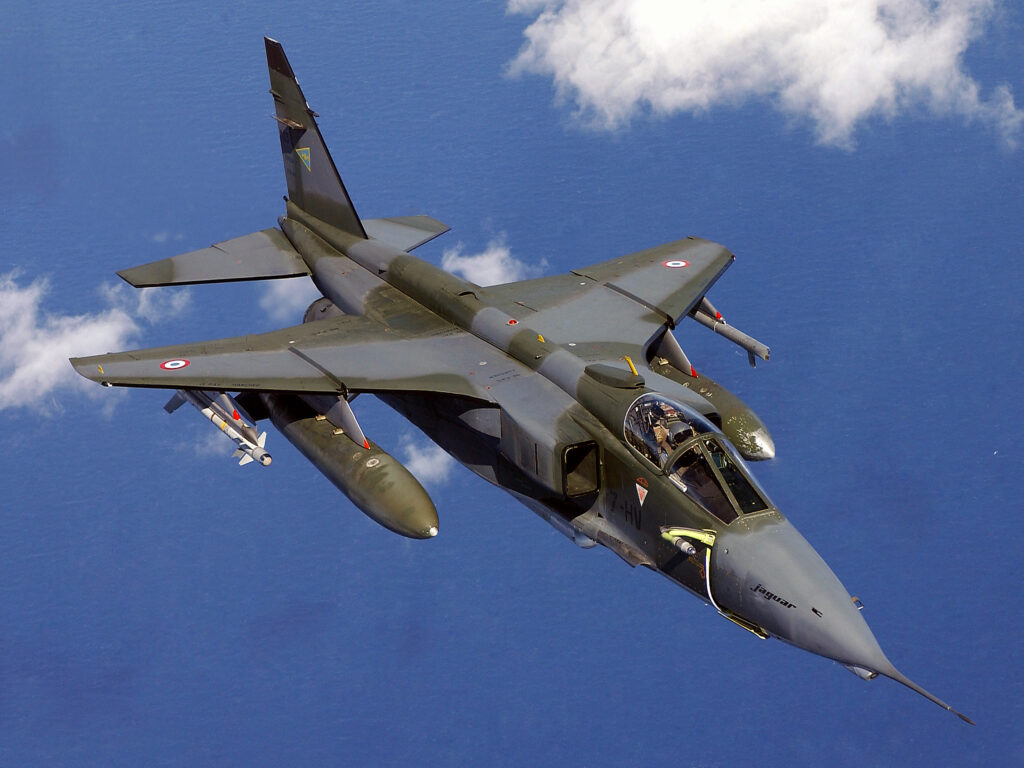
The SEPECAT Jaguar is a British-French supersonic jet attack aircraft originally used by the Royal Air Force and French Air Force in the close air support and nuclear strike roles. Built by SEPECAT (a joint venture between Breguet and British Aircraft Corporation), 573 aircraft were produced between 1968 and 1981. The Jaguar was exported to India, Oman, Ecuador, and Nigeria, and saw combat in Mauritania, Chad, the Gulf War, and Bosnia. As of 2025, the Jaguar remains in service with the Indian Air Force.
Design & Development
The Jaguar programme began in the early 1960s, originally conceived as an advanced jet trainer. When the AFVG program was canceled in 1967, the Jaguar’s role evolved into a full-capability strike aircraft. SEPECAT was formed in 1966 as a joint venture to produce the airframe, while Rolls-Royce and Turbomeca jointly developed the Adour afterburning turbofan engine.
The first prototype flew on 8 September 1968, going supersonic on its third flight. The aircraft features a swept-wing, twin-engine monoplane design with tall tricycle landing gear. British versions were the most demanding, requiring supersonic performance, laser rangefinder/marked-target seeker (LRMTS), and advanced navigation systems. India later license-produced the Jaguar through Hindustan Aeronautics Limited and developed the DARIN avionics suite.
Operational History
The Jaguar made its combat debut in December 1977 against Polisario Front forces in Mauritania. French Jaguars were extensively deployed in Chad during the 1970s-80s conflict with Libya. In the 1991 Gulf War, both RAF and French Jaguars flew combat missions, praised for exceptional mechanical reliability. RAF Jaguars were later upgraded with TIALD laser designator pods for operations in Bosnia (Operation Deliberate Force, 1995).
France retired the Jaguar in 2005, the UK in 2007, and Oman in 2014. The Indian Air Force continues to operate upgraded Jaguars with modern avionics, maritime strike radar, and precision weapons capability.
Capabilities
- Maximum speed of Mach 1.6 (1,700 km/h) at altitude
- 850 km combat radius — greater than comparable aircraft like the MiG-27
- 4,500 kg external weapons load on multiple hardpoints
- Nuclear delivery capability (AN-52 bomb for France, WE.177 for UK)
- Overwing missile pylons — unusual feature freeing underwing stations for ordnance
- 30-minute engine change for rapid turnaround
- LRMTS and TIALD laser designation for precision strikes
Armament & Weapons
- Guns: 2× 30mm ADEN (RAF) or DEFA (French) cannon
- Air-to-air missiles: AIM-9 Sidewinder, R.550 Magic (overwing pylons)
- Anti-ship missiles: Sea Eagle, AGM-84 Harpoon (maritime variants)
- Anti-radiation missiles: Martel AS.37
- Bombs: BAP 100, CBU-87 cluster bombs, Rockeye, laser-guided bombs
- Rockets: Matra LR.F2 pods, CRV7 high-velocity rockets
- Nuclear weapons: AN-52 (France), WE.177 (UK), tactical nuclear role for India
Video
Frequently Asked Questions
Is the Jaguar still in service?
Yes, as of 2025, the SEPECAT Jaguar remains in active service with the Indian Air Force, which operates upgraded variants with modern DARIN avionics and maritime strike capability. France retired the type in 2005 and the UK in 2007.
Why was the Jaguar a joint British-French project?
In the 1960s, both Britain and France identified needs for an advanced trainer with ground attack capability. A 1965 Memorandum of Understanding led to the formation of SEPECAT, pooling resources and splitting production between two assembly lines. This was one of the first major Anglo-French military aircraft programs.
How did the Jaguar perform in the Gulf War?
The Jaguar excelled during the Gulf War with exceptional mechanical reliability. Both RAF and French Air Force Jaguars flew numerous ground attack sorties. However, its dated avionics were a limitation — French Jaguars needed Mirage F1CR escorts for navigation, which led to significant post-war upgrade programs.