✈️ Aircraft Specifications
| Designation | Q-5 / A-5 |
| Manufacturer | Nanchang Aircraft Manufacturing Company |
| Country of Origin | China |
| First Flight | 1965 |
| Length | 15.65 m (51.3 ft) |
| Max Speed (Mach) | 1.12 |
| Max Speed (km/h) | 1,210 km/h |
| Service Ceiling | 16,500 m (54,137 ft) |
| Range | 2,000 km (1,242 mi) |
| Engine | 2x Liming Wopen-6A afterburning turbojet |
| Crew | 1 |
| Status | Retired |
Overview
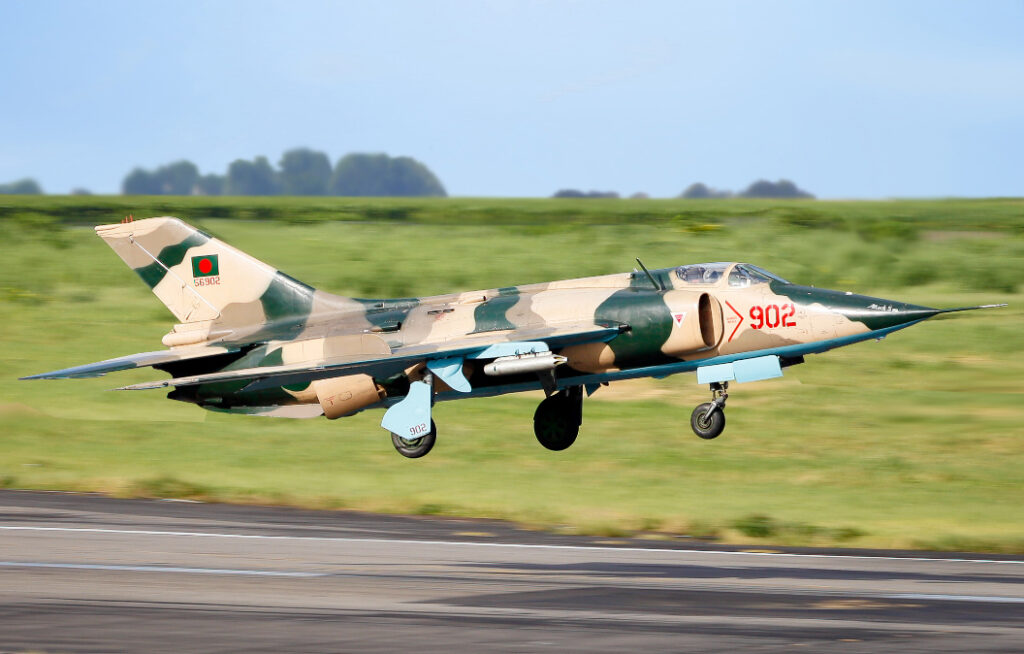
The Nanchang Q-5 (NATO reporting name: Fantan), known as the A-5 in its export versions, is a Chinese-built single-seat, twin-engine ground-attack aircraft based on the Shenyang J-6 (MiG-19). First flying on 4 July 1965 and entering service in 1970, approximately 1,300 aircraft were produced over four decades. The Q-5 served as China’s primary close air support platform and was exported to Pakistan, Bangladesh, Myanmar, Sudan, and North Korea.
Design & Development
In August 1958, the PLA requested development of a dedicated attack aircraft. Chief designer Lu Xiaopeng adapted the MiG-19 design with a longer, area-ruled fuselage to reduce transonic drag and accommodate a 4-meter internal weapons bay. The air intakes were moved to the fuselage sides, freeing the nose for planned radar (which was never fitted). New wings with greater area and reduced sweep were incorporated.
The Q-5 retains the J-6’s Liming Wopen WP-6A turbojet engines. Production drawings were completed in 1960, but political upheaval canceled the project in 1961. A small team kept it alive until work restarted at Nanchang, with the first flight on 4 July 1965. Series production began in 1969.
Numerous variants followed, including the Q-5A with expanded fuel capacity, nuclear-capable Q-5Jia, and export A-5C with Western equipment. Joint modernization programs with Italy (Q-5M) and France (Q-5K) were largely halted after the 1989 political events.
Operational History
The Q-5 served as the backbone of China’s tactical air attack capability for decades. Some variants were retrofitted for tactical nuclear delivery to counter potential Soviet invasion. Export A-5 variants saw combat service: Sudan’s Air Force used A-5s during the War in Darfur, and Myanmar Air Force A-5Cs conducted ground attack sorties including a 2015 incident where bombs accidentally fell on Chinese territory.
The PLAAF retired its Q-5 fleet in 2017, with the type being replaced by the JH-7 and J-16. Pakistan retired its A-5C fleet by 2011, and Bangladesh by 2015. Myanmar remains the sole military operator as of 2025.
Capabilities
- Maximum speed of Mach 1.12 (1,210 km/h) — supersonic at altitude
- Internal weapons bay for 1,000 kg of ordnance (unique for its class)
- 2,000 km range with internal fuel tank conversion
- 10 external hardpoints (later variants) for 2,000 kg external stores
- Rate of climb: 103 m/s (20,300 ft/min)
- Nuclear delivery capability (Q-5A variant)
Armament & Weapons
- Guns: 2× 23mm Norinco Type 23-2K cannon (100 rounds per gun)
- Air-to-air missiles: PL-2, PL-5, PL-7, R.550 Magic, AIM-9 Sidewinder (export)
- Bombs: 50 kg to 500 kg unguided bombs, LS-500J laser-guided bombs
- Rockets: 57mm, 90mm, 130mm unguided rocket pods
- Anti-runway weapons: Matra Durandal (export variants)
- Cluster bombs: BL755
- Nuclear weapons: Kuangbiao-1 tactical nuclear bomb (Q-5Jia)
Video
Frequently Asked Questions
Is the Q-5 based on the MiG-19?
Yes, the Q-5 was developed from the Shenyang J-6, which was China’s license-produced version of the Soviet MiG-19. However, the Q-5 features extensive redesign including a longer fuselage, repositioned air intakes, new wings, and an internal weapons bay, making it substantially different from its ancestor.
Why is it called “Fantan”?
Fantan is the NATO reporting name assigned to the Q-5. NATO assigns code names to Chinese and Russian military aircraft for identification purposes. The name references the Chinese card game Fan-Tan and has no connection to the aircraft’s actual Chinese designation.
How many countries operated the Q-5?
The Q-5/A-5 was operated by at least seven countries: China (PLAAF and PLANAF), Pakistan, Bangladesh, Myanmar, Sudan, and reportedly North Korea. Myanmar remains the sole military operator as of 2025 with approximately 20 aircraft in service.