✈️ Aircraft Specifications
| Designation | X-2 (ATD-X) |
| Manufacturer | Mitsubishi Heavy Industries |
| Country of Origin | Japan |
| First Flight | 2016 |
| Length | 14.2 m (46.6 ft) |
| Max Speed (Mach) | 1.6 |
| Max Speed (km/h) | 2,000 km/h |
| Service Ceiling | 15,240 m (50,002 ft) |
| Engine | 2x IHI XF5-1 low-bypass turbofan (49 kN each with afterburner) |
| Crew | 1 |
| Status | Prototype |
Overview
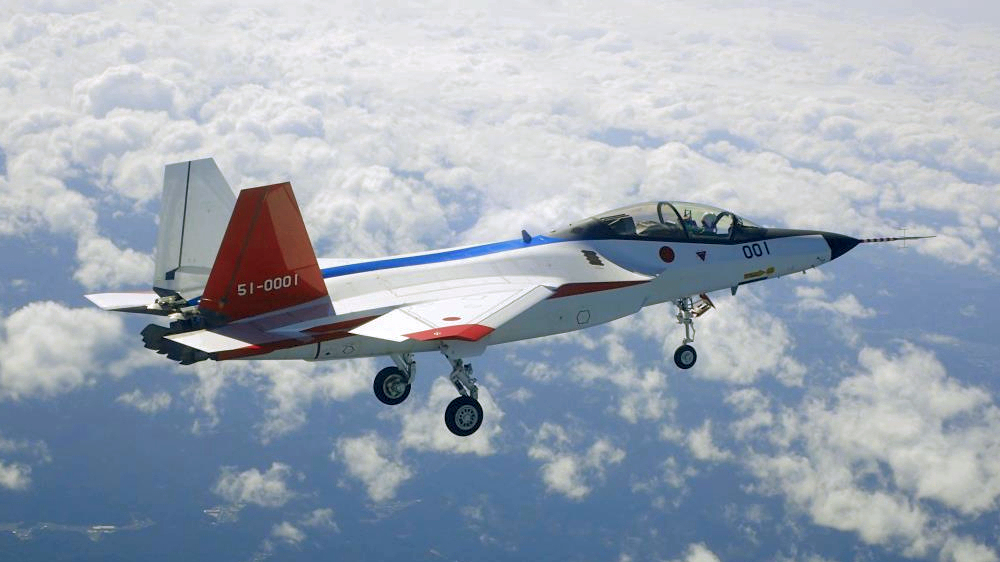
The Mitsubishi X-2 Shinshin (心神, meaning “mind” or “spirit”), formerly known as the ATD-X (Advanced Technology Demonstrator-X), is a Japanese experimental stealth aircraft developed to test advanced fighter technologies. Built by Mitsubishi Heavy Industries under the direction of Japan’s Ministry of Defense, the X-2 made its maiden flight on 22 April 2016, making Japan the fourth nation to develop and fly an indigenous stealth aircraft after the United States, Russia, and China. The program’s success directly led to the development of the next-generation Mitsubishi F-X (Global Combat Air Programme).
Design & Development
The X-2 program originated from Japan’s inability to purchase F-22 Raptors from the United States, as Congress had banned exports to protect the aircraft’s stealth technology. This necessitated Japan developing its own modern stealth fighter capabilities. A 1/5 scale radio-controlled model flew in 2006 to gather data on high angle-of-attack performance and test self-repairing flight control systems.
The decision to proceed with the full-scale demonstrator was taken in 2007, with construction beginning in 2009 at Mitsubishi’s Komaki South Plant under a 40 billion yen budget. The aircraft features advanced stealth shaping, thrust vectoring nozzles on its two IHI XF5-1 turbofan engines, and fly-by-optics flight control systems. At 14.2 m long with a 9.1 m wingspan, the X-2 weighs approximately 9,000-13,000 kg at takeoff.
The prototype was officially unveiled on 29 January 2016 and completed its maiden flight on 22 April 2016, taking off from Nagoya Airfield and landing at JASDF Gifu Air Field after a 26-minute flight. Testing concluded in March 2018 after 34 sorties of the planned 50 flights.
Operational History
The X-2 was never intended for operational service — it served purely as a technology demonstrator. Its flight testing validated stealth design principles, thrust vectoring control, advanced materials, and sensor technologies that would inform Japan’s next-generation fighter program. By July 2018, Japan had gathered sufficient data to proceed with the next phase, eventually joining with the UK and Italy in the Global Combat Air Programme (GCAP) for a sixth-generation fighter.
Capabilities
- Role: Stealth technology demonstrator
- Max Speed: Supersonic (estimated Mach 1.6+)
- Engines: 2× IHI XF5-1 low-bypass turbofans (49 kN each with afterburner)
- Crew: 1
- Length: 14.2 m
- Wingspan: 9.1 m
- Features: Stealth shaping, thrust vectoring, fly-by-optics, self-repairing flight controls
Video
Frequently Asked Questions
Why did Japan build the X-2?
After the US Congress banned F-22 exports, Japan needed to develop indigenous stealth fighter technology. The X-2 served as a technology demonstrator to validate key technologies for a future operational fighter.
Is the X-2 a combat aircraft?
No, the X-2 is purely an experimental technology demonstrator. It was not designed for combat operations and carried no weapons. Its technologies feed into the Mitsubishi F-X / GCAP program.
What came after the X-2?
The X-2’s success led to the Global Combat Air Programme (GCAP), a joint sixth-generation fighter project between Japan, the UK, and Italy, expected to enter service in the 2030s.