✈️ Aircraft Specifications
| Designation | Ye-152 |
| Manufacturer | Mikoyan-Gurevich |
| Country of Origin | Soviet Union |
| First Flight | 1961 |
| Length | 18.14 m (59.5 ft) |
| Max Speed (Mach) | 2.65 |
| Max Speed (km/h) | 2,810 km/h |
| Service Ceiling | 21,000 m (68,901 ft) |
| Range | 1,470 km (913 mi) |
| Engine | Tumansky R-15-300 afterburning turbojet |
| Crew | 1 |
| Status | Prototype |
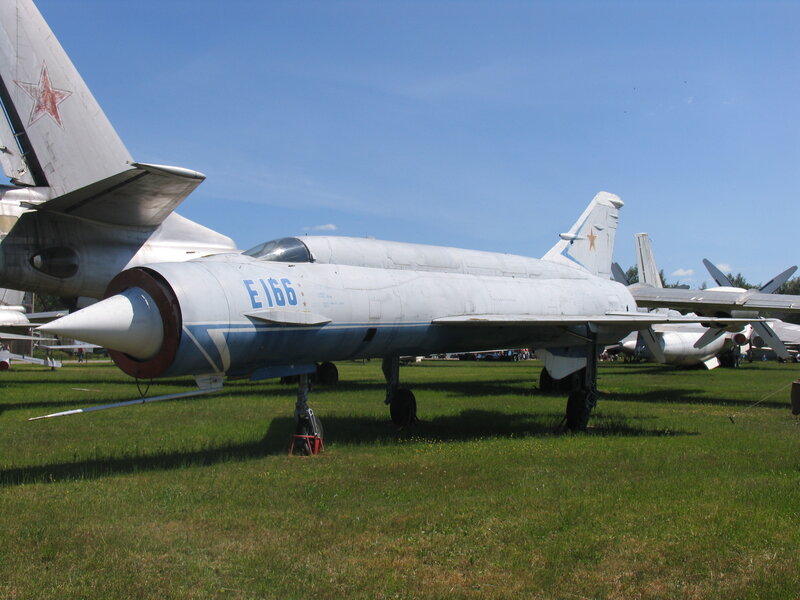
Overview
The Mikoyan-Gurevich Ye-152 was an experimental Soviet prototype interceptor aircraft developed as part of the Ye-150 family of heavy interceptors in the late 1950s. Designed to fulfill the Soviet Air Defence Forces’ (PVO) requirement for a high-speed, high-altitude interceptor capable of automatic interceptions, the Ye-152 represented the cutting edge of Soviet aviation technology. Two single-engined Ye-152 prototypes were built, along with a twin-engined Ye-152A variant. The Ye-152 set world speed records under the disguised designation “Ye-166” and achieved remarkable performance figures including speeds exceeding Mach 2.6, but the program was ultimately cancelled due to persistent engine reliability issues.
Design & Development
The Ye-152 was part of a series of heavy interceptors that the Mikoyan-Gurevich bureau developed starting in 1955, following from the swept-wing I-3 series and the I-75. The requirement called for a supersonic interceptor significantly larger and heavier than the contemporary MiG-21 — the Ye-150 weighed 12,345 kg and was 18.14 meters long, compared to the MiG-21F’s 4,819 kg and 15.76 meters.
The initial Ye-150 prototype first flew on 8 July 1960, powered by the new Tumansky R-15 engine. Testing revealed extraordinary performance — Mach 2.65 at 19,100 meters using less than full throttle, and a service ceiling of at least 21,000 meters — but was severely hampered by the R-15 engine’s extremely short service life, barely sufficient for ground checks and a single flight.
The two Ye-152 prototypes (Ye-152-1 and Ye-152-2) received improved R-15-300 engines and featured cropped delta wings with greater area to carry the large K-80 or K-9 missiles on wingtip launchers. The Ye-152-1 first flew on 21 April 1961. Despite setting world records, the program was ultimately doomed by the R-15 engine’s poor reliability and the cancellation of the intended K-9/Uragan-5B weapon system. The twin-engined Ye-152A variant, using two reliable Tumansky R-11 engines, flew from July 1959 but crashed in 1965.
Operational History
The Ye-152 never entered operational service, remaining a prototype throughout its existence. Its most notable achievements were the world speed records set by the Ye-152-1 in 1961 and 1962, which were registered with the FAI under the disguised designation “Ye-166” to conceal the true nature of the program. These records demonstrated the potential of Soviet aviation engineering even as the aircraft’s practical limitations prevented production.
The twin-engined Ye-152A was publicly displayed during the 1961 Aviation Day flypast at Tushino, where Western observers assigned it the NATO reporting name “Flipper” and erroneously identified it as a MiG-23. The Ye-152M (modified Ye-152-2 with a convergent-divergent nozzle and briefly fitted canards) was eventually retired to the Central Air Force Museum at Monino, misleadingly marked as the “Ye-166.” The knowledge and experience gained from the Ye-150 family contributed to future Mikoyan interceptor designs.
Capabilities
- Maximum Speed: Mach 2.65+ (2,810+ km/h) at 19,100 meters — achieved with less than full throttle
- Service Ceiling: 21,000+ meters (68,900+ feet) — phenomenal altitude capability
- Engine (Ye-152): 1 × Tumansky R-15-300 afterburning turbojet
- Engine (Ye-152A): 2 × Tumansky R-11 afterburning turbojets for improved reliability
- Delta Wing: Cropped delta planform with large area for missile carriage
- Automatic Interception: Designed for Uragan-5 integrated weapons system for automatic guidance to interception point
- World Records: Set FAI-recognized speed records under the designation Ye-166
Armament & Weapons
- Air-to-Air Missiles: 2 × K-9 or K-80 (R-4) large air-to-air missiles on wingtip launchers
- Fire Control: TsKB Almaz TsP-1 fire control radar (planned for Ye-152A)
- Weapons System: Uragan-5B (Hurricane-5B) integrated weapons system for automatic interception (cancelled)
- Note: The Ye-151 cannon-armed variant with rotating turret-mounted TKB-495 cannons was designed but never built
Video
Frequently Asked Questions
What was the relationship between the Ye-152 and the MiG-21?
While both aircraft were produced by the Mikoyan-Gurevich bureau and shared a general delta-wing layout, the Ye-152 was a completely different and much larger aircraft. The Ye-152 was designed as a heavy interceptor weighing over 12,000 kg — more than twice the MiG-21’s weight — and was intended for the PVO air defense forces rather than the tactical air force. They represent different branches of Mikoyan’s design philosophy.
Why was the Ye-152 never put into production?
The primary reason was the extreme unreliability of the Tumansky R-15 engine, which had a service life barely sufficient for pre-flight checks and a single flight. Additionally, the intended K-9 missile and Uragan-5B weapons system were cancelled, leaving the aircraft without its primary armament. The twin-engined Ye-152A with more reliable R-11 engines showed promise but crashed in 1965.
What records did the Ye-152 set?
The Ye-152-1 set world speed records in 1961 and 1962 that were registered with the Fédération Aéronautique Internationale (FAI) under the disguised designation “Ye-166.” The aircraft achieved speeds exceeding Mach 2.65 at 19,100 meters altitude, and demonstrated a service ceiling of over 21,000 meters — remarkable figures that showcased the potential of Soviet aerospace engineering.
References & Sources
- Wikipedia – Mikoyan-Gurevich Ye-150 Family
- Gordon, Yefim. Soviet/Russian Heavy Interceptors. Midland Publishing, 2004.
- Williams, Anthony G. Flying Guns: The Modern Era. Crowood Press, 2004.