✈️ Aircraft Specifications
| Designation | HF-24 |
| Manufacturer | Hindustan Aeronautics Limited (HAL) |
| Country of Origin | India |
| First Flight | 1961 |
| Length | 15.87 m (52.1 ft) |
| Max Speed (Mach) | 1.02 |
| Max Speed (km/h) | 1,112 km/h |
| Service Ceiling | 15,000 m (49,215 ft) |
| Range | 1,600 km (994 mi) |
| Engine | 2x Bristol Siddeley Orpheus 703 turbojet |
| Crew | 1 |
| Status | Retired |
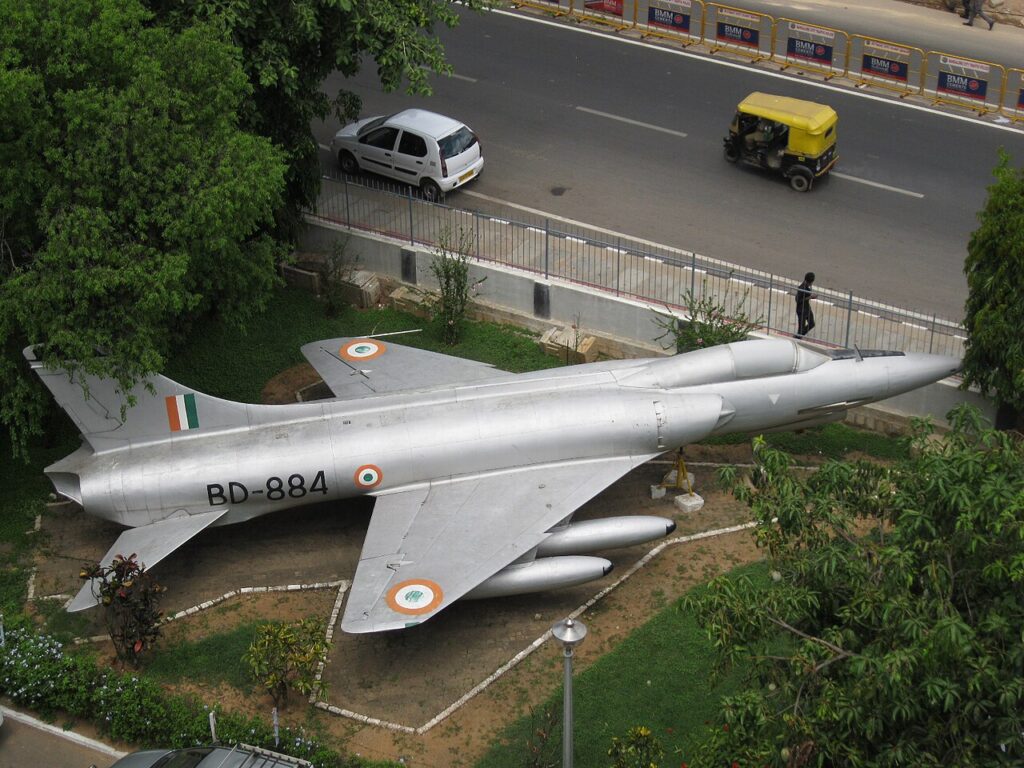
Overview
The HAL HF-24 Marut (“Spirit of the Tempest”) holds the distinction of being India’s first indigenously developed jet fighter aircraft. Designed by legendary German aeronautical engineer Kurt Tank and manufactured by Hindustan Aeronautics Limited (HAL), the Marut served with the Indian Air Force from 1967 until its retirement in 1990. A total of 147 aircraft were built, and while it never achieved its intended supersonic performance due to engine limitations, the Marut proved itself as a capable fighter-bomber, particularly during the Indo-Pakistani War of 1971.
Design & Development
Development of the HF-24 began in 1956 when HAL formally started design work on a supersonic fighter project under the guidance of Kurt Tank, who had previously designed the famous Focke-Wulf Fw 190 for Germany. The Indian government, led by Prime Minister Jawaharlal Nehru, authorized the project as a means to develop India’s modern aircraft industry.
The original requirement called for a Mach 2-capable twin-engine combat aircraft. HAL first built a full-scale wooden glider designated X-241 to test the aerodynamic configuration, which flew 86 times before being damaged. The first powered prototype flew on 17 June 1961, fitted with Bristol Siddeley Orpheus 703 turbojets — the same engines used in the Folland Gnat. Unfortunately, these engines lacked the power to push the Marut past Mach 1, and despite numerous attempts to source or develop more powerful engines, no suitable replacement was ever found.
The Indian government’s refusal of a Rolls-Royce proposal to develop an improved Orpheus, combined with post-1974 nuclear test sanctions that cut off engine spares, ultimately sealed the Marut’s fate as an underpowered platform.
Operational History
The first production Marut was officially accepted by the IAF on 1 April 1967. Despite its performance limitations, the Marut served effectively as a ground-attack platform. During the Indo-Pakistani War of 1971, Marut squadrons played a notable role in the Battle of Longewala, conducting ground attack missions against Pakistani forces in the Rajasthan desert.
No Maruts were lost in air-to-air combat during the 1971 war, though three were brought down by ground fire. The aircraft’s twin-engine configuration and manual flight control backup provided excellent survivability in the low-level attack role. By 1982, the Marut was becoming obsolescent, and it was gradually phased out through the late 1980s, with final retirement in 1990.
Capabilities
- Role: Fighter-bomber / Ground attack
- Max Speed: Mach 1.02 (1,112 km/h)
- Service Ceiling: 15,000 m (49,200 ft)
- Range: 1,600 km
- Engines: 2× Bristol Siddeley Orpheus 703 turbojets (21.6 kN each)
- Crew: 1 (single-seat) or 2 (trainer variant)
Armament & Weapons
- 4× 30 mm ADEN cannons
- Retractable Matra rocket pack with 50× SNEB 68 mm rockets
- Up to 1,814 kg of external ordnance on four underwing hardpoints
- 227 kg and 454 kg conventional bombs
- T-10 rockets and air-to-ground munitions
Video
Frequently Asked Questions
Why couldn’t the Marut go supersonic?
The Bristol Siddeley Orpheus 703 engines lacked sufficient thrust. The aircraft was designed for more powerful engines that were never sourced due to political and economic factors.
How did the Marut perform in combat?
The Marut performed well as a ground-attack platform during the 1971 Indo-Pakistani War, with no losses in air-to-air combat.
Who designed the HF-24 Marut?
German aeronautical engineer Kurt Tank, famous for the Focke-Wulf Fw 190, designed the Marut after joining HAL in the 1950s.
How many Maruts were built?
147 Maruts were manufactured, including 18 two-seat trainer variants.