✈️ Aircraft Specifications
| Designation | F-11A |
| Manufacturer | Grumman |
| Country of Origin | United States |
| First Flight | 1954 |
| Length | 14.31 m (47 ft) |
| Max Speed (Mach) | 1.1 |
| Max Speed (km/h) | 1,207 km/h |
| Service Ceiling | 12,770 m (41,898 ft) |
| Range | 2,044 km (1,269 mi) |
| Engine | 1× Wright J65-W-18 turbojet |
| Crew | 1 |
| Status | Retired |
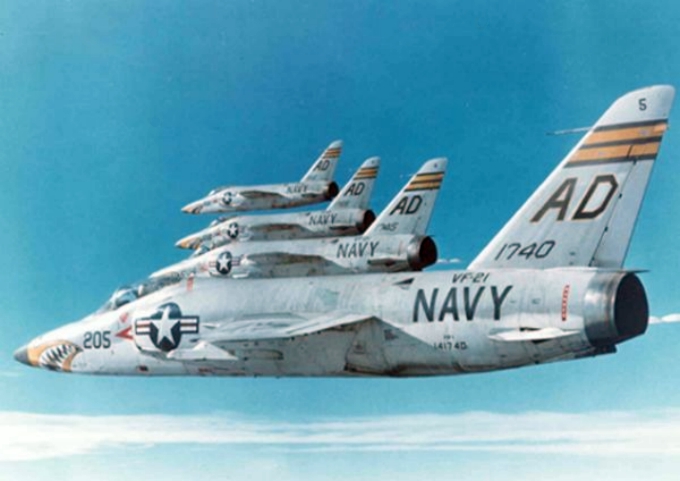
Overview
The Grumman F-11 Tiger is a supersonic single-seat carrier-based fighter that holds the unique distinction of being the first jet aircraft to shoot itself down. Grumman’s first supersonic fighter, the Tiger served with the U.S. Navy from 1956 and was famously flown by the Blue Angels flight demonstration team from 1957 to 1969. Though its frontline carrier service was brief, the F-11 held the world altitude record and pioneered several aerodynamic innovations.
Design & Development
The Tiger originated in 1952 as Grumman’s internal design study (G-98) to improve the F9F Cougar. However, the design team incorporated the area rule and other advanced concepts, resulting in an entirely new aircraft. The F-11 featured a novel wing with full-span leading edge slats, trailing edge flaps, and spoilers for roll control instead of traditional ailerons.
The first prototype flew on 30 July 1954 and nearly reached Mach 1 despite using a non-afterburning Wright J65 engine. The second prototype, with the afterburning engine, exceeded Mach 1. A total of 199 Tigers were produced, with the last delivered on 23 January 1959.
Operational History
The Tiger entered carrier service in 1956, operating from multiple carriers including USS Forrestal, USS Saratoga, and USS Ranger. However, its frontline career was short — the F-11 was outperformed by the competing Vought F-8 Crusader, which was faster and had better endurance. The Wright J65 engine also proved unreliable.
On 21 September 1956, test pilot Tom Attridge achieved aviation infamy when his F-11 shot itself down during a test-firing of its 20mm cannons. The bullets, fired in a shallow dive, decelerated and fell along a ballistic trajectory that intersected with the aircraft’s own flight path as it accelerated in a steeper dive. The Tiger was subsequently used as an advanced trainer and most famously served with the Blue Angels from 1957 to 1969.
Capabilities
- Maximum Speed: Mach 1.1 (1,207 km/h / 750 mph)
- Service Ceiling: 12,770 m (41,900 ft)
- Range: 2,044 km (1,270 miles)
- Engine: 1× Wright J65-W-18 afterburning turbojet, 10,500 lbf thrust
- Crew: 1
- Length: 14.31 m (46.9 ft)
- First Flight: 30 July 1954
- Units Built: 199
Armament & Weapons
- Cannon: 4× 20 mm Colt Mk 12 cannons
- Missiles: 4× AIM-9 Sidewinder air-to-air missiles on underwing pylons
- Rockets: Capability for unguided rockets on external hardpoints
Video
Frequently Asked Questions
Did the F-11 Tiger really shoot itself down?
Yes. On 21 September 1956, test pilot Tom Attridge fired his cannons in a shallow dive, then entered a steeper dive. The bullets followed a ballistic arc and the aircraft caught up to them, striking the windscreen and engine. Attridge crash-landed but survived.
Why did the Blue Angels fly the F-11 Tiger?
The F-11 Tiger was selected for its attractive appearance, good low-speed handling, and responsive controls — ideal qualities for precision aerobatic flying. The Blue Angels flew the Tiger from 1957 to 1969.
How many F-11 Tigers were built?
A total of 199 Grumman F-11 Tigers were produced for the United States Navy between 1954 and 1959.