✈️ Aircraft Specifications
| Designation | F4D-1 (F-6A) |
| Manufacturer | Douglas Aircraft Company |
| Country of Origin | United States |
| First Flight | 1951 |
| Length | 13.93 m (45.7 ft) |
| Max Speed (Mach) | 1.05 |
| Max Speed (km/h) | 1,211 km/h |
| Service Ceiling | 16,764 m (55,003 ft) |
| Range | 1,126 km (699 mi) |
| Engine | Pratt & Whitney J57-P-8 turbojet |
| Crew | 1 |
| Status | Retired |
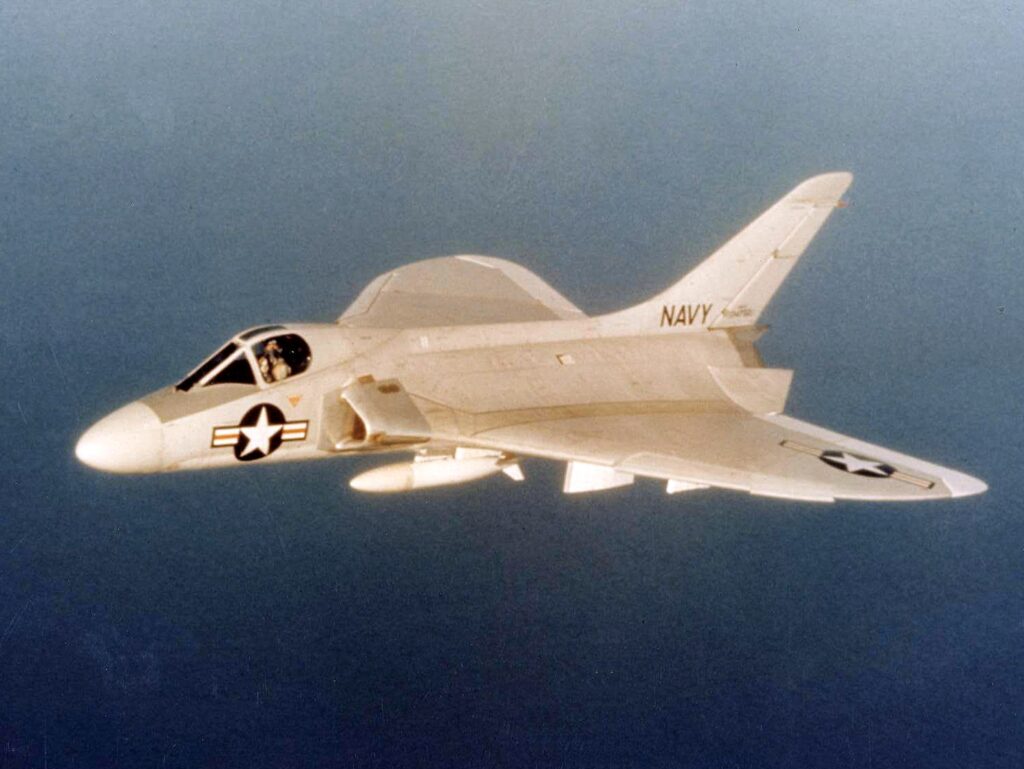
Overview
The Douglas F4D Skyray (later redesignated F-6 Skyray) is an American carrier-based fighter and interceptor aircraft designed and produced by the Douglas Aircraft Company. First flying on 23 January 1951, the Skyray was a distinctive delta-winged aircraft that became the first carrier-launched aircraft to hold the world’s absolute speed record at 752.9 mph (1,211 km/h). A total of 422 Skyrays were built, serving with the United States Navy and Marine Corps from April 1956 until retirement in February 1964. It was the last fighter produced by Douglas before its merger with McDonnell Aircraft.
Design & Development
The Skyray originated from the D-571-1 design study performed by Douglas and funded by the U.S. Navy in the late 1940s. The concept called for a fast-climbing pure interceptor with a delta wing, inspired by the research of German aerodynamicist Alexander Lippisch. The design was intended to intercept and destroy enemy aircraft at 50,000 feet within five minutes of alarm — a critical requirement given Cold War concerns about Soviet bomber threats to carrier battle groups.
Originally designed around the Westinghouse J40 turbojet, the Skyray faced significant development challenges when the J40 was cancelled without delivering any production engines. The prototype had to be fitted with a temporary Allison J35 engine, while the long-term replacement became the more powerful Pratt & Whitney J57. This engine change required substantial redesign due to the J57’s considerably larger size, which delayed the program significantly.
The XF4D-1 prototype first flew on 23 January 1951, but production-standard aircraft didn’t fly until June 1954 due to the numerous aerodynamic problems and engine changes. Despite these delays, the Skyray set impressive records including a world absolute speed record and a time-to-altitude record — reaching 49,221 feet from a standing start in just 2 minutes and 36 seconds at a 70-degree pitch angle.
Operational History
The Skyray was declared ready for fleet service in April 1956 and entered service with both the U.S. Navy and Marine Corps. It was widely reported as the first naval fighter to break the speed of sound in level flight. The aircraft served as a point-defense interceptor aboard aircraft carriers, designed to rapidly climb and intercept incoming threats.
Despite its impressive performance capabilities, the Skyray had a relatively brief service life and never saw combat. By the early 1960s, it was being replaced by more advanced aircraft, and the last operational Skyrays were withdrawn from service in February 1964. A handful continued flying with NACA (later NASA) for experimental purposes until the end of the decade. The F5D Skylancer was developed as an advanced follow-on, but it also did not enter production service.
Capabilities
- Maximum Speed: Mach 1.05 (1,211 km/h / 752 mph) — set world absolute speed record
- Service Ceiling: 16,764 meters (55,000 feet)
- Range: 1,126 km (700 miles)
- Time-to-Altitude: 49,221 ft in 2 minutes 36 seconds from standing start — exceptional climb performance
- Engine: 1 × Pratt & Whitney J57-P-8 turbojet with afterburner, producing 65.8 kN (14,500 lbf) with afterburner
- Delta Wing Design: Unique bat-wing planform derived from Alexander Lippisch’s research
- Carrier Operations: Fully equipped for carrier takeoff and recovery operations
Armament & Weapons
- Cannons: 4 × 20 mm Colt Mk 12 cannons
- Rockets: 76 × 2.75-inch Mk 4/Mk 40 Folding-Fin Aerial Rockets (FFAR) in wing-mounted pods
- Air-to-Air Missiles: 2 × AIM-9 Sidewinder infrared-guided missiles on later variants
- Hardpoints: 6 underwing pylons for various ordnance configurations
Video
Frequently Asked Questions
Was the Douglas F4D Skyray a delta wing aircraft?
The Skyray featured a unique modified delta wing planform often described as a “bat wing” design. It was heavily influenced by the research of German aerodynamicist Alexander Lippisch, whose work on delta and tailless aircraft designs was studied by Douglas engineers after World War II.
What records did the F4D Skyray set?
The Skyray set the world absolute speed record at 752.9 mph (1,211 km/h) and an impressive time-to-altitude record, climbing from a standing start to 49,221 feet in just 2 minutes and 36 seconds. It was the first carrier-launched aircraft to hold the world’s absolute speed record.
Why was the F4D Skyray redesignated F-6?
In 1962, the U.S. Department of Defense unified the designation systems of the Navy, Air Force, and Army under the Tri-Service aircraft designation system. Under this new system, the F4D Skyray was redesignated as the F-6 Skyray, though by this time the aircraft was already nearing the end of its operational service.
References & Sources
- Wikipedia – Douglas F4D Skyray
- Boeing Heritage – F4D Skyray
- Francillon, René J. McDonnell Douglas Aircraft since 1920. Naval Institute Press, 1988.