✈️ Aircraft Specifications
| Designation | D-558-II |
| Manufacturer | Douglas Aircraft Company |
| Country of Origin | United States |
| First Flight | 1948 |
| Length | 12.80 m (42 ft) |
| Max Speed (Mach) | 2.005 |
| Max Speed (km/h) | 2,078 km/h |
| Service Ceiling | 25,370 m (83,239 ft) |
| Range | 320 km (199 mi) |
| Engine | Westinghouse J34 turbojet + Reaction Motors XLR8 rocket |
| Crew | 1 |
| Status | Retired |
Overview
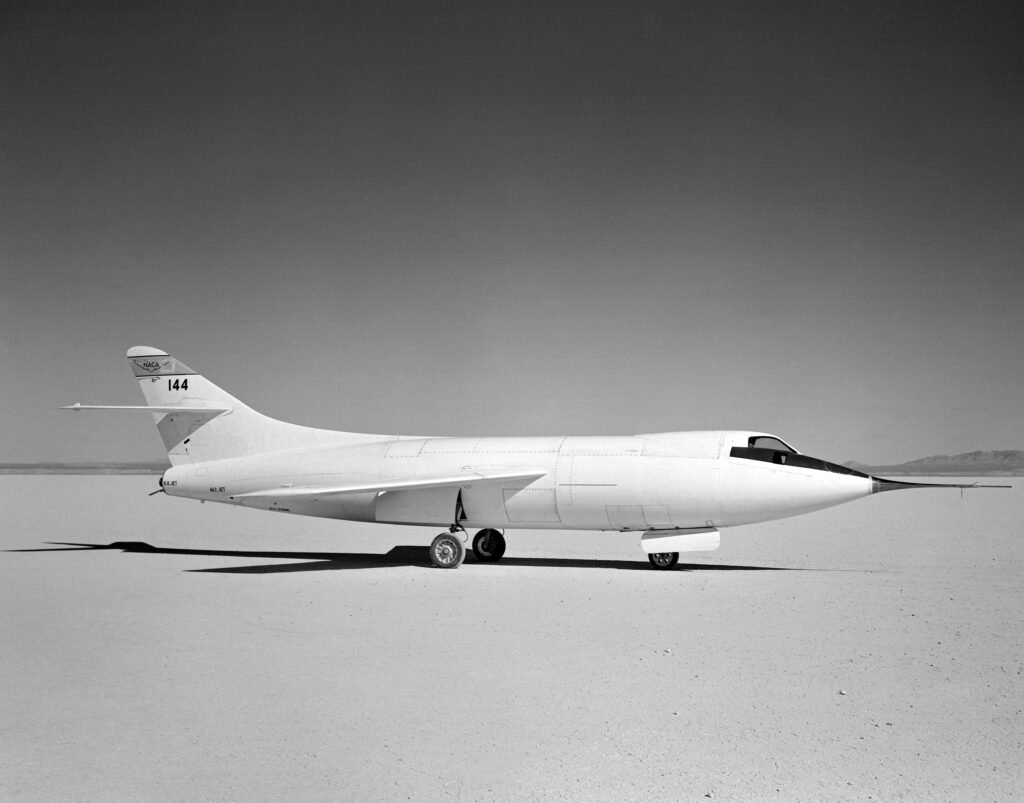
The Douglas D-558-II Skyrocket was a groundbreaking rocket-and-jet-powered research aircraft that made aviation history on 20 November 1953 when NACA pilot Scott Crossfield flew it to Mach 2.005 — becoming the first aircraft to exceed twice the speed of sound. Built for the U.S. Navy, three Skyrockets flew a combined 313 research flights that provided critical data on swept-wing behavior at transonic and supersonic speeds.
Design & Development
The D-558-II was the phase-two aircraft of a three-phase research program. When it became clear that the straight-winged D-558-1 Skystreak could not accommodate both rocket and jet power, the Skyrocket was designed as an entirely new aircraft with 35-degree swept wings and a 40-degree swept horizontal stabilizer.
The aircraft featured a mixed-power configuration: a Westinghouse J34-40 turbojet for takeoff, climb, and landing, and a four-chamber Reaction Motors XLR8-RM-6 rocket engine for high-speed research. The fuselage was primarily magnesium, and the wings and empennage were aluminum. A safety feature allowed the forward fuselage to disconnect in emergencies.
Operational History
Douglas pilot John F. Martin made the first flight on 4 February 1948 at Muroc Army Airfield. The three Skyrockets accumulated an impressive 313 flights over their research careers. In 1950, Douglas pilot Bill Bridgeman flew NACA 144 in a rocket-only configuration, reaching Mach 1.88 and an unofficial altitude record of 79,494 ft (24,230 m).
Marine Lt. Col. Marion Carl achieved a new unofficial altitude record of 83,235 ft (25,370 m) on 21 August 1953. The crowning achievement came on 20 November 1953, when Crossfield reached Mach 2.005 (1,291 mph) at approximately 72,000 ft — the only Mach 2 flight the Skyrocket ever made. NACA engineers had chilled the fuel and waxed the fuselage to squeeze every ounce of performance from the aircraft.
The program concluded on 20 December 1956. All three Skyrockets survive today in museums across the United States.
Capabilities
- Maximum Speed: Mach 2.005 (2,078 km/h / 1,291 mph) — first Mach 2 flight in history
- Maximum Altitude: 83,235 ft (25,370 m) — unofficial record
- Powerplant: Westinghouse J34-WE-40 turbojet (3,000 lbf) + Reaction Motors XLR8-RM-6 rocket (6,000 lbf)
- Wing Sweep: 35 degrees
- Total Flights: 313 across three aircraft
- Crew: 1 pilot
Video
Frequently Asked Questions
Was the D-558-II the first aircraft to break Mach 2?
Yes. On 20 November 1953, NACA pilot Scott Crossfield flew the D-558-II Skyrocket to Mach 2.005 (1,291 mph), making it the first aircraft to exceed twice the speed of sound.
How was the Skyrocket launched for high-speed flights?
For rocket-powered flights, the Skyrocket was carried aloft beneath a Navy P2B (B-29 variant) to about 30,000 ft and then air-launched. For mixed-power flights, it could take off conventionally using its turbojet.
What research contributions did the Skyrocket make?
The D-558-II provided critical data on swept-wing pitch-up, lateral stability, buffeting characteristics, and the effects of rocket exhaust on aerodynamic stability. This research directly aided the development of the Century Series fighters.