✈️ Aircraft Specifications
| Designation | F-102A |
| Manufacturer | Convair |
| Country of Origin | United States |
| First Flight | 1953 |
| Length | 20.84 m (68.4 ft) |
| Max Speed (Mach) | 1.25 |
| Max Speed (km/h) | 1,328 km/h |
| Service Ceiling | 16,200 m (53,152 ft) |
| Range | 1,304 km (810 mi) |
| Engine | Pratt and Whitney J57-P-23 turbojet |
| Crew | 1 |
| Status | Retired |
Overview
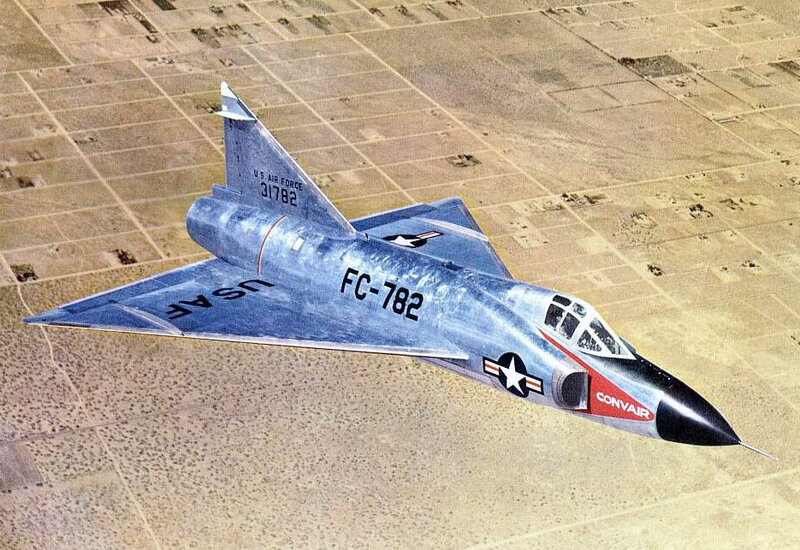
The Convair F-102 Delta Dagger is an American interceptor aircraft and a member of the prestigious Century Series. It holds the distinction of being the first operational supersonic interceptor and delta-wing fighter in United States Air Force service. Designed to counter the threat of Soviet strategic bombers during the Cold War, the F-102 was the backbone of American air defenses throughout the late 1950s and 1960s. A total of 1,000 aircraft were built, serving with the USAF, Air National Guard, and exported to Greece and Turkey.
Design & Development
The F-102 originated from the USAF’s 1948 “1954 Ultimate Interceptor” requirement, designed to be built around a sophisticated fire-control system capable of automatically guiding the aircraft to intercept incoming bombers. The Hughes MG-3 fire-control system was selected in 1950, and Convair won the airframe competition with its delta-wing design, drawing on extensive research into delta configurations.
The first YF-102 prototype flew on 24 October 1953, but results were disappointing — the aircraft could not achieve supersonic flight. This led to a revolutionary redesign applying Richard Whitcomb’s area rule, reshaping the fuselage with a distinctive “Coke bottle” waist and adopting a thinner, wider wing. The redesigned YF-102A demonstrated dramatically improved performance, saving the entire program.
The F-102 featured an internal weapons bay carrying guided missiles and rockets, controlled by the MG-10 fire-control system (a simplified version of the originally planned unit). The aircraft was designed to be part of the Semi-Automatic Ground Environment (SAGE) air defense network, receiving ground-controlled intercept commands through a data link that could automatically fly the aircraft to its target.
Operational History
The F-102 entered USAF service in April 1956 and rapidly replaced subsonic interceptors like the F-89 Scorpion. The aircraft was deployed to Air Defense Command bases across the continental United States, as well as to overseas locations in Europe and the Pacific to defend against Soviet bomber threats.
During the Vietnam War, F-102s were deployed in a limited capacity, flying bomber escort missions for B-52s and even performing ground attack sorties — roles far removed from their designed interceptor mission. The aircraft proved vulnerable in the combat environment, and 15 were lost during the conflict.
By the mid-1960s, the F-102 was being transferred from active duty to Air National Guard units as more capable aircraft like the F-106 Delta Dart entered service. Many retired F-102s were converted to QF-102 Full Scale Aerial Target drones for weapons testing. The type was completely retired from operational service by 1976, with Greek and Turkish examples serving until 1979.
Capabilities
- Supersonic interceptor — First operational USAF supersonic delta-wing interceptor
- SAGE integration — Automated ground-controlled intercept via data link with the SAGE air defense system
- Internal weapons bay — Clean aerodynamic profile with all weapons carried internally
- Area rule design — Pioneering application of the area rule for transonic drag reduction
- All-weather capability — MG-10 fire-control system for interception in all weather conditions
- Mach 1.25 top speed — Maximum speed of 1,328 km/h at altitude
Armament & Weapons
- Guided missiles: 6× AIM-4 Falcon semi-active radar-homing and infrared-guided missiles in internal bay
- Rockets: 24× 2.75-inch (70mm) FFARs (Folding-Fin Aerial Rockets) in internal bay doors
- Nuclear option: 1× MB-1 Genie nuclear-tipped air-to-air rocket (on some variants)
- Note: No internal gun — the F-102 relied entirely on missile and rocket armament
Video
Frequently Asked Questions
What is the area rule and why was it important to the F-102?
The area rule, discovered by NACA researcher Richard Whitcomb, states that the total cross-sectional area of an aircraft should change smoothly along its length for minimum transonic drag. When the original YF-102 failed to achieve supersonic flight, Convair redesigned the fuselage with a pinched “Coke bottle” waist to compensate for the area added by the wings. This fix was so successful that it saved the entire program and became a fundamental principle of supersonic aircraft design.
What was the difference between the F-102 and F-106?
The F-106 Delta Dart was originally designated F-102B and was intended as the “ultimate” version of the Delta Dagger. However, the redesign was so extensive that it was given a separate designation. The F-106 featured a more powerful J75 engine (vs. J57), the advanced MA-1 fire-control system, Mach 2+ speed capability, and improved maneuverability. The F-106 was considered one of the finest interceptors ever built and served until 1988.
Did the F-102 carry any guns?
No, the F-102 did not carry an internal gun. The aircraft relied entirely on AIM-4 Falcon guided missiles and FFARs carried in an internal weapons bay. This missile-only philosophy was common among 1950s interceptors designed to engage bombers at long range, but proved to be a significant limitation when the aircraft was pressed into service in Vietnam, where close-range engagements sometimes occurred.
Did any famous people fly the F-102?
Yes, future US President George W. Bush flew the F-102 during his service with the Texas Air National Guard’s 147th Fighter Interceptor Group from 1968 to 1973. Several other pilots who went on to notable careers also flew the Delta Dagger during their military service.