✈️ Aircraft Specifications
| Designation | J-7G |
| Manufacturer | Chengdu Aircraft Corporation |
| Country of Origin | China |
| First Flight | 1966 |
| Length | 14.885 m (48.8 ft) |
| Max Speed (Mach) | 2.0 |
| Max Speed (km/h) | 2,175 km/h |
| Service Ceiling | 17,500 m (57,418 ft) |
| Range | 1,480 km (919 mi) |
| Engine | Liyang WP-13F afterburning turbojet |
| Crew | 1 |
| Status | Active |
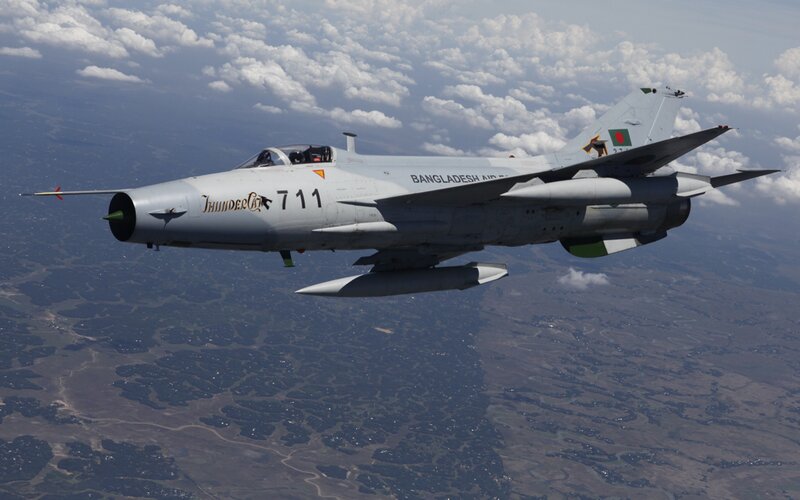
Overview
The Chengdu J-7 (NATO reporting name: Fishcan) is a Chinese fighter aircraft derived from the Soviet Mikoyan-Gurevich MiG-21 through a technology transfer agreement signed in 1962. With over 2,400 units built between 1965 and 2013, the J-7 became one of the most widely exported Chinese military aircraft and a cornerstone of the People’s Liberation Army Air Force for decades. The export version, designated F-7, served with numerous air forces across Asia, Africa, and the Middle East, earning a reputation as a reliable, low-cost supersonic fighter.
Design & Development
In 1962, the Soviet Union and China signed a technology transfer agreement for the MiG-21. However, the documentation provided was reportedly incomplete, forcing Chinese engineers to reverse-engineer significant portions of the aircraft. Production was initially established at the Shenyang Aircraft Factory, but the Cultural Revolution severely disrupted manufacturing, and true mass production was only achieved during the 1980s.
While sharing the MiG-21’s basic configuration — a tailed delta-wing layout with a nose intake — the J-7 incorporated differences in hydraulic systems and internal fuel arrangements. Successive variants introduced improvements in armament, avionics, and wing design. The J-7E featured a distinctive double-delta wing for improved maneuverability, while the J-7G incorporated a helmet-mounted sight and PL-8 missile capability.
Production was carried out by both the Chengdu Aircraft Corporation and the Guizhou Aircraft Industry Corporation. The final J-7s produced were 16 F-7BGI aircraft delivered to the Bangladesh Air Force in 2013, marking the end of nearly five decades of production. The J-7 program provided invaluable experience that contributed to China’s later development of more advanced fighters.
Operational History
The J-7 entered PLAAF service on 17 January 1966 and served as a frontline fighter for decades. The aircraft formed the numerical backbone of Chinese air power during the Cold War era, complementing the older Shenyang J-6 (MiG-19 derivative).
Export customers employed the F-7 variant in various conflicts. Pakistani F-7s served during tensions with India, while several African nations including Tanzania, Zimbabwe, and Sri Lanka deployed the type in combat operations. The aircraft’s low cost, simplicity, and ease of maintenance made it attractive to developing nations seeking affordable supersonic fighter capability.
The PLAAF retired its J-7 fleet in 2023, replaced by fourth-generation fighters like the J-10 and J-11. However, the type continues in service with several export operators including Bangladesh, North Korea, and Pakistan. The J-7’s legacy includes spawning the Guizhou JL-9 advanced trainer, which uses J-7-derived components and technology.
Capabilities
- Mach 2.0 top speed — Supersonic performance comparable to the original MiG-21
- Lightweight and agile — Excellent instantaneous turn rate and responsiveness at combat speeds
- Low acquisition cost — Fraction of the price of Western fighters, making it accessible to developing nations
- Easy maintenance — Simple design requiring minimal ground support equipment
- Short-field capability — Able to operate from semi-prepared and shorter airstrips
- Helmet-mounted sight — Available on J-7G variant for off-boresight missile cueing
Armament & Weapons
- Internal guns: 2× Type 30-1 30mm cannons (early variants) or 1× GSh-23L 23mm twin-barrel cannon (later variants)
- Air-to-air missiles: PL-2/PL-2B infrared, PL-5 infrared, PL-7 infrared, PL-8 all-aspect infrared on later variants
- Bombs: Up to 500 kg of free-fall bombs on underwing hardpoints
- Rockets: Various rocket pod configurations including Type 57-2 and Type 90-1 pods
- External stores: 5 hardpoints (1 centerline, 4 underwing)
Video
Frequently Asked Questions
What is the difference between the J-7 and MiG-21?
The J-7 is a Chinese-produced derivative of the MiG-21, initially based on technology transferred from the Soviet Union in 1962. While early J-7s were nearly identical to the MiG-21F-13, later variants diverged significantly with Chinese-developed improvements to avionics, weapons systems, and wing design. The J-7E’s double-delta wing and the J-7G’s glass cockpit are distinctly Chinese innovations not found on any MiG-21 variant.
How many countries operate the J-7/F-7?
The J-7/F-7 has been exported to over 15 countries across Asia, Africa, and the Middle East. Major operators have included Pakistan, Bangladesh, Myanmar, North Korea, Egypt, Tanzania, Zimbabwe, Sri Lanka, Sudan, Nigeria, Albania, and Iran. The aircraft’s combination of supersonic performance and low cost made it one of China’s most successful military exports.
Why was the J-7 produced for so long?
The J-7 remained in production for nearly 50 years (1965-2013) due to continued export demand from developing nations seeking affordable supersonic fighter capability. While technologically surpassed by modern fighters, the J-7/F-7 offered unbeatable value for nations with limited defense budgets. China also continued to improve the design, keeping it competitive enough for export sales even as the PLAAF transitioned to more advanced types.