✈️ Aircraft Specifications
| Designation | F/A-18E/F |
| Manufacturer | Boeing |
| Country of Origin | United States |
| First Flight | 1995 |
| Length | 18.31 m (60.1 ft) |
| Max Speed (Mach) | 1.8 |
| Max Speed (km/h) | 1,915 km/h |
| Service Ceiling | 15,240 m (50,002 ft) |
| Range | 2,346 km (1,457 mi) |
| Engine | 2× General Electric F414-GE-400 turbofan |
| Crew | 1-2 |
| Status | Active |
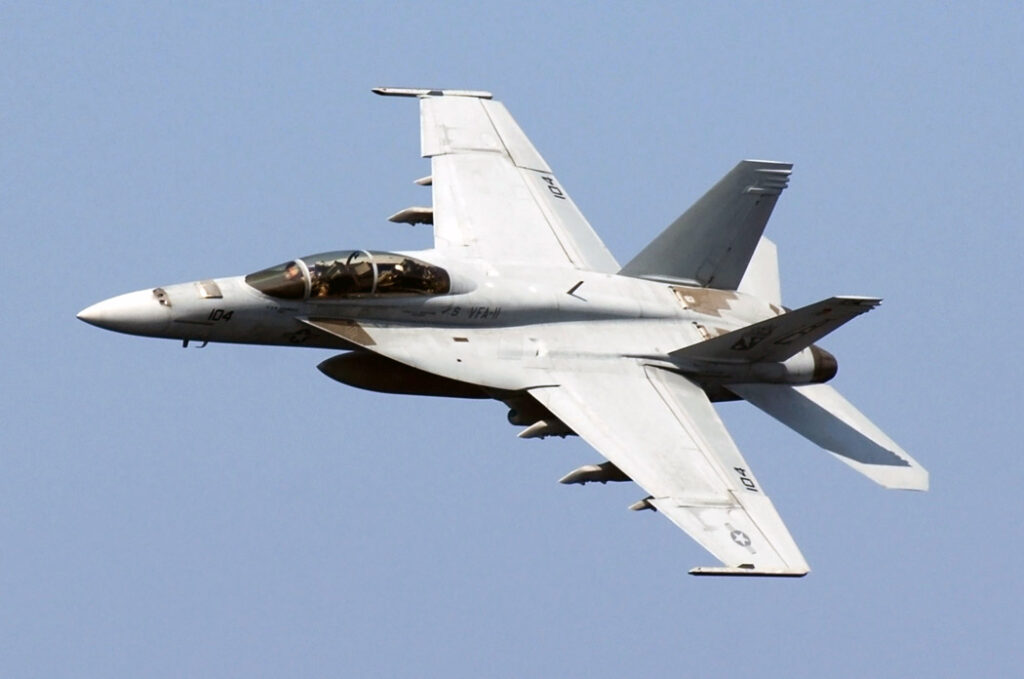
Overview
The Boeing F/A-18E/F Super Hornet is an American twin-engine, carrier-capable, multirole fighter aircraft that has served as the backbone of U.S. Navy carrier aviation since the early 2000s. An enlarged and significantly upgraded derivative of the original McDonnell Douglas F/A-18 Hornet, the Super Hornet — commonly called “Rhino” by Navy pilots — first flew on 29 November 1995 and entered fleet service in 1999. With over 632 aircraft built, it operates with the United States Navy, Royal Australian Air Force, and Kuwait Air Force.
Design & Development
The Super Hornet traces its lineage through the Northrop YF-17 Cobra and original F/A-18 Hornet to McDonnell Douglas’s “Hornet 2000” concept of the 1980s. Following the cancellation of the A-12 Avenger II stealth attack aircraft in 1991, the Navy needed an affordable, versatile platform to replace both the aging A-6 Intruder attack aircraft and eventually the F-14 Tomcat interceptor.
The F/A-18E (single-seat) and F/A-18F (two-seat) variants are approximately 25% larger than the original Hornet, with 42% more internal fuel capacity, a redesigned wing with an additional hardpoint, and more powerful General Electric F414-GE-400 turbofan engines producing 98 kN each. The airframe incorporates some radar cross-section reduction features. An electronic warfare variant, the EA-18G Growler, was subsequently developed to replace the EA-6B Prowler.
Operational History
The Super Hornet entered fleet service in 1999 and achieved Initial Operating Capability in 2001 — just in time for extensive combat operations following the September 11 attacks. The F/A-18E/F has been used extensively in combat over Afghanistan, Iraq, and Syria, flying strike, close air support, air superiority, and reconnaissance missions. It replaced the F-14 Tomcat, which was retired in 2006.
Australia ordered the F/A-18F in 2007 to replace its F-111C fleet, with RAAF Super Hornets entering service in December 2010. Kuwait also ordered the type. The Super Hornet is planned to be replaced by the F/A-XX next-generation carrier fighter in the 2030s. The aircraft has proven highly versatile, regularly serving as an airborne tanker using the buddy refueling system alongside its combat missions.
Capabilities
- Maximum Speed: Mach 1.8 (~1,915 km/h)
- Service Ceiling: 15,240 m (50,000 ft)
- Combat Range: 2,346 km (1,275 nmi)
- Carrier Operations: Full catapult launch and arrested recovery capability
- Buddy Tanking: Can be configured as an airborne refueling tanker
- Engines: 2× GE F414-GE-400 (98 kN each with afterburner)
- Radar: AN/APG-79 AESA radar (Block II and later)
Armament & Weapons
- Internal Gun: 1× M61A2 Vulcan 20mm rotary cannon (412 rounds)
- Hardpoints: 11 stations for up to 8,050 kg of ordnance
- Air-to-Air: AIM-9X Sidewinder, AIM-120 AMRAAM
- Air-to-Surface: AGM-84 Harpoon, AGM-88 HARM, AGM-154 JSOW, AGM-158 JASSM
- Precision Bombs: JDAM, Paveway LGB series, SDB
- External Fuel: Up to 5 external fuel tanks
Video
Frequently Asked Questions
What is the difference between the F/A-18E and F/A-18F?
The F/A-18E is the single-seat variant, while the F/A-18F is the two-seat tandem variant. Both share the same airframe and performance, but the F model accommodates a weapons systems officer (WSO) in the rear seat for more complex strike and training missions.
Why is it called “Rhino”?
U.S. Navy pilots adopted the nickname “Rhino” to distinguish the Super Hornet from the original, smaller F/A-18 Hornet (called “Legacy Hornet”) on carrier decks and in radio communications.
Is the Super Hornet a stealth aircraft?
The Super Hornet incorporates some signature reduction features in its design, including careful shaping and radar-absorbing materials, but it is not a full stealth aircraft like the F-35. The conformal fuel tanks and weapons pod options on Block III further reduce its radar signature.
What will replace the Super Hornet?
The F/A-XX program (Next Generation Air Dominance for the Navy) is planned to produce a successor beginning in the 2030s. The Super Hornet Block III upgrade is extending the aircraft’s capability and relevance until that replacement arrives.