✈️ Aircraft Specifications
| Designation | Su-33 |
| Manufacturer | Sukhoi |
| Country of Origin | Russia |
| First Flight | 1987 |
| Length | 21.19 m (69.5 ft) |
| Max Speed (Mach) | 2.17 |
| Max Speed (km/h) | 2,300 km/h |
| Service Ceiling | 17,000 m (55,777 ft) |
| Range | 3,000 km (1,863 mi) |
| Engine | 2× Saturn AL-31F3 afterburning turbofans |
| Crew | 1 |
| Status | Active |
Overview
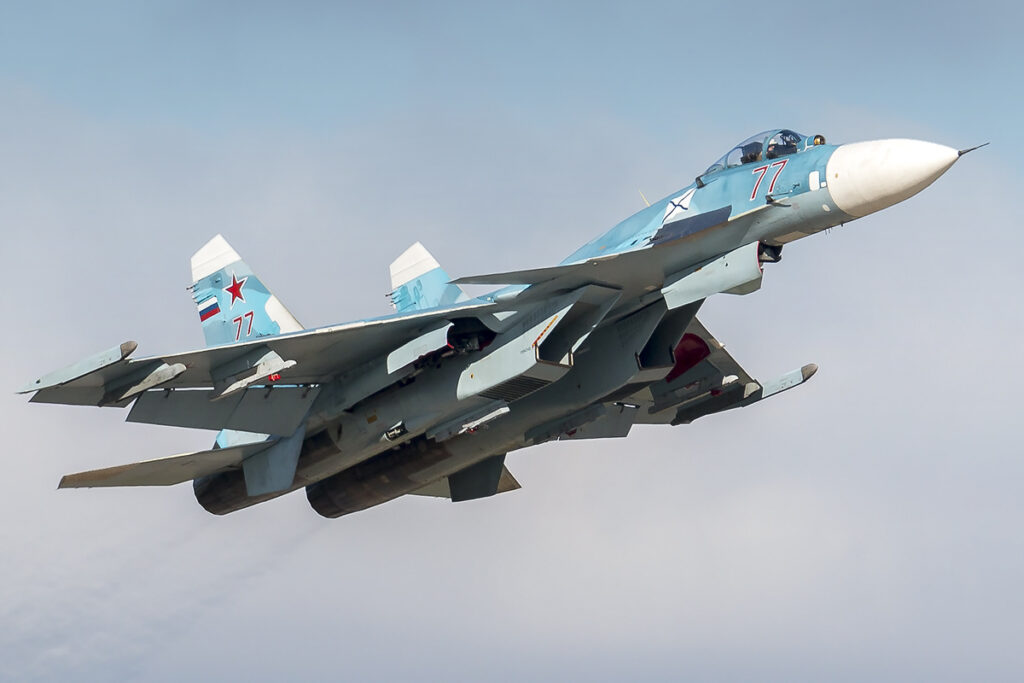
The Sukhoi Su-33 (NATO: Flanker-D) is a carrier-based air superiority fighter derived from the Su-27. It operates exclusively from Russia’s only aircraft carrier, Admiral Kuznetsov, and is the heaviest carrier-based fighter in the world.
Design & Development
The Su-33 is a navalized Su-27 with canard foreplanes for improved low-speed handling, strengthened landing gear, folding wings and tailplanes for carrier storage, an arresting hook, and a retractable refueling probe. It uses ski-jump takeoff rather than catapult launch.
Operational History
Developed as the Su-27K, the Su-33 first flew in 1987 and entered service in 1998. Only 24 production aircraft were built. They have deployed aboard Admiral Kuznetsov, including combat operations off Syria in 2016-2017, where one Su-33 was lost in a landing accident. The small fleet has seen limited use due to the carrier’s frequent mechanical problems.
Capabilities
- Ski-jump carrier takeoff
- Canard foreplanes for low-speed control
- Folding wings and stabilizers
- Mach 2.17 top speed
- 6,500 kg weapons load
Armament & Weapons
- 1× GSh-30-1 30mm cannon (150 rounds)
- Air-to-Air: R-27 (AA-10), R-73 (AA-11), R-77 (AA-12)
- Anti-Ship: Kh-41 Moskit (theoretically)
- 12 hardpoints total
Video
Frequently Asked Questions
What carrier does the Su-33 operate from?
The Su-33 operates exclusively from Admiral Kuznetsov, Russia’s only aircraft carrier.
How does it take off without a catapult?
The Su-33 uses a ski-jump ramp at the bow of the carrier, combined with its powerful engines and canard foreplanes for short takeoff.
How many Su-33s exist?
Only 24 production Su-33s were built, with the fleet shrinking due to attrition. Russia plans to replace them with the MiG-29K.