✈️ Aircraft Specifications
| Designation | Su-9 |
| Manufacturer | Sukhoi |
| Country of Origin | Soviet Union |
| First Flight | 1956 |
| Length | 16.77 m (55 ft) |
| Max Speed (Mach) | 2.0 |
| Max Speed (km/h) | 2,120 km/h |
| Service Ceiling | 20,000 m (65,620 ft) |
| Range | 1,350 km (838 mi) |
| Engine | 1x Lyulka AL-7F-1-100 afterburning turbojet |
| Crew | 1 |
| Status | Retired |
Overview
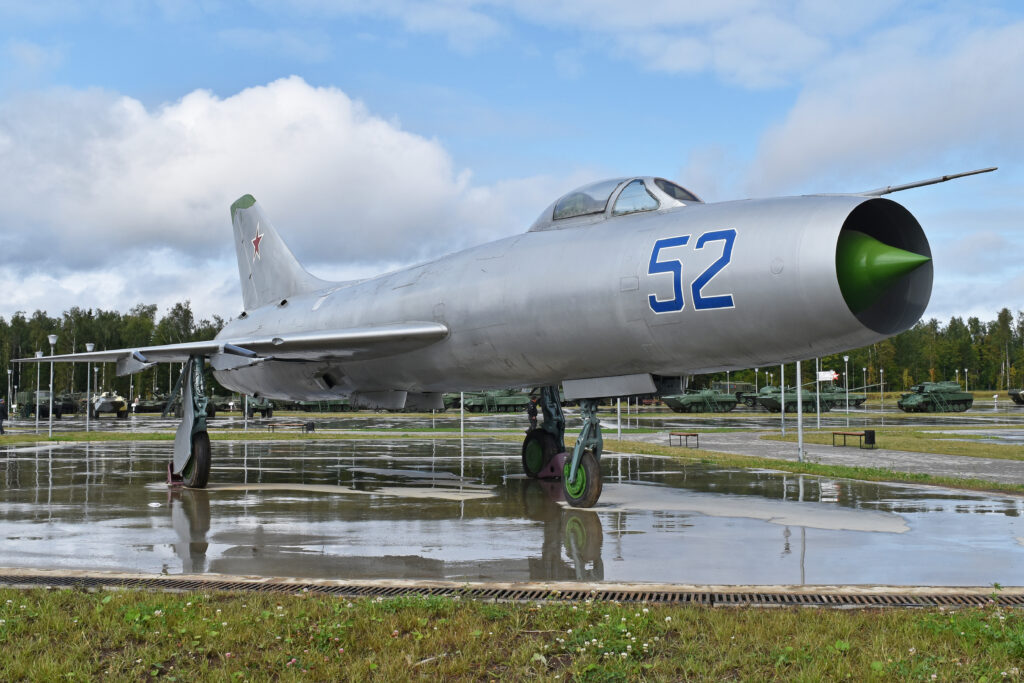
The Sukhoi Su-9 (NATO reporting name: Fishpot) was a single-engine, all-weather, missile-armed interceptor developed for the Soviet Air Defense Forces. Entering service in 1959, approximately 1,150 were built, making it one of the most numerous Soviet interceptors of the early Cold War era. The Su-9 is notable for its involvement in the interception attempt of Francis Gary Powers U-2 spy plane in 1960.
Design & Development
The Su-9 emerged from TsAGI aerodynamic studies during the Korean War. Developed in parallel with the swept-wing Su-7 fighter-bomber, the Su-9 used a 53-degree delta wing for reduced supersonic drag and increased fuel volume. It first flew on 24 June 1956 as the T-405 prototype.
The aircraft featured a nose-mounted shock cone intake housing the TsD-30 radar, powered by a single Lyulka AL-7F turbojet. Unlike the Su-7 swept wing, the delta configuration was optimized for the interceptor role. The controls were light and responsive but unforgiving of pilot error, a stark contrast to the Su-7 heavier but more docile handling.
Operational History
The Su-9 entered PVO service in 1959 and quickly became a cornerstone of Soviet air defense. On 4 September 1959, a modified Su-9 (T-431) piloted by Vladimir Ilyushin set a world altitude record of 28,852 m (94,658 ft).
The Su-9 most famous mission came on 1 May 1960 during the Francis Gary Powers U-2 incident. An unarmed Su-9 piloted by Captain Igor Mentyukov was directed to ram the U-2 spy plane. The ramming attempt failed due to the extreme speed differential, and Mentyukov later claimed his slipstream may have contributed to the U-2 breakup.
The Su-9 was never exported and served exclusively with Soviet forces. It was gradually replaced by the Su-11 and Su-15 during the 1970s, with some converted to unmanned target drones. By 1981, at least 243 were stored at Bobrovka air base.
Capabilities
- Maximum Speed: Mach 2.0 (2,120 km/h) at altitude
- Service Ceiling: 20,000 m (65,600 ft)
- Range: 1,350 km (internal fuel); 1,800 km with external tanks
- Powerplant: 1x Lyulka AL-7F-1-100 afterburning turbojet (94.12 kN / 21,158 lbf)
- Radar: TsD-30 in nose shock cone
- Total Built: approximately 1,150
Armament & Weapons
- 4x K-5 (AA-1 Alkali) beam-riding air-to-air missiles (later replaced by K-55/R-55 IR-homing missiles)
- No internal cannon armament
- 2 fuselage pylons for drop tanks
Video
Frequently Asked Questions
Was the Su-9 involved in shooting down the U-2?
An unarmed Su-9 attempted to ram Powers U-2 on 1 May 1960 but failed. The pilot later claimed his slipstream contributed to the U-2 breakup, though the official account credits an SA-2 missile.
Why was the Su-9 not exported?
As a frontline interceptor with sensitive radar and avionics systems, the Su-9 was considered too classified to share with Warsaw Pact allies or client states.
What replaced the Su-9?
The Su-9 was succeeded by the improved Su-11 Fishpot-C (with better radar and missiles) and ultimately by the much more capable twin-engine Su-15 Flagon.