✈️ Aircraft Specifications
| Designation | YF-23A |
| Manufacturer | Northrop/McDonnell Douglas |
| Country of Origin | United States |
| First Flight | 1990 |
| Length | 20.55 m (67.4 ft) |
| Max Speed (Mach) | 2.2 |
| Max Speed (km/h) | 2,335 km/h |
| Service Ceiling | 19,812 m (65,003 ft) |
| Range | 4,500 km (2,795 mi) |
| Engine | 2× Pratt & Whitney YF119 or General Electric YF120 |
| Crew | 1 |
| Status | Cancelled |
Overview
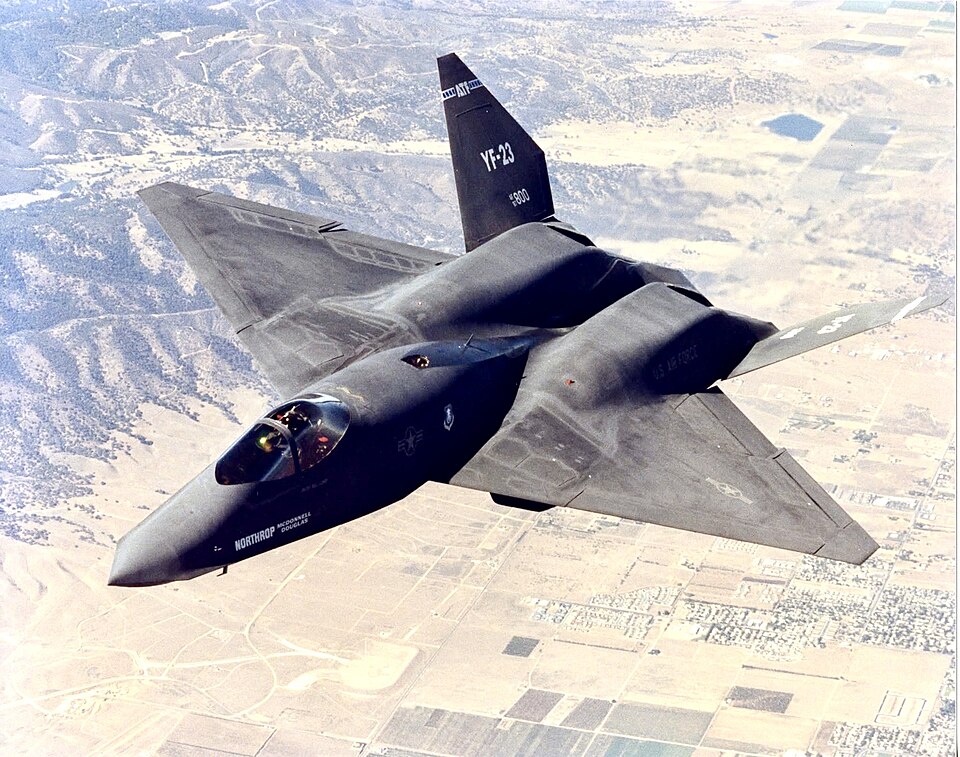
The Northrop YF-23 Black Widow II was one of the most advanced fighter prototypes ever built, designed as a stealth air superiority fighter for the U.S. Air Force’s Advanced Tactical Fighter (ATF) competition. Competing against the Lockheed YF-22, the YF-23 was stealthier and faster but ultimately lost the competition in 1991. Only two prototypes were built, and they remain among the most intriguing “what if” aircraft in aviation history.
Design & Development
In the 1980s, the USAF launched the ATF program to counter emerging Soviet threats like the Su-27 and MiG-29. Northrop, teamed with McDonnell Douglas, developed the YF-23 with an emphasis on stealth and speed. The aircraft featured a distinctive diamond-shaped wing planform, ruddervator tail surfaces angled in a V-configuration, and deeply buried engines with trapezoidal exhaust nozzles designed to minimize infrared and radar signatures.
Two prototypes were built: PAV-1 “Spider” (powered by Pratt & Whitney YF119 engines) and PAV-2 “Gray Ghost” (powered by General Electric YF120 engines). PAV-1 first flew on 27 August 1990. The YF-23 demonstrated supercruise capability — sustaining supersonic flight without afterburner — at Mach 1.43 with the YF119 and Mach 1.6 with the YF120.
Operational History
The YF-23 never entered operational service. During the ATF fly-off competition, both prototypes demonstrated impressive performance. However, on 23 April 1991, the USAF announced that the YF-22 team had won, citing lower risk and superior agility. The YF-22 was developed into the F-22 Raptor.
After the competition, both YF-23 prototypes were placed in storage. In 2004, Northrop Grumman briefly revived interest in the YF-23 as a basis for a regional bomber concept, but this was not pursued. Today, PAV-1 is displayed at the National Museum of the United States Air Force in Dayton, Ohio, and PAV-2 is at the Western Museum of Flight in Torrance, California.
Capabilities
- Maximum Speed: Mach 2.2+ (estimated 2,335 km/h / 1,451 mph)
- Service Ceiling: ~19,812 m (65,000 ft)
- Range: ~4,500 km (2,796 miles, estimated)
- Engines: 2× Pratt & Whitney YF119 or 2× General Electric YF120 turbofans
- Crew: 1
- Length: 20.55 m (67.4 ft)
- First Flight: 27 August 1990
- Units Built: 2 prototypes
Armament & Weapons
- Internal Weapons Bays: Designed to carry AIM-120 AMRAAM and AIM-9 Sidewinder missiles internally
- Stealth Priority: All weapons carried internally to maintain low radar cross-section
- Note: As a technology demonstrator, weapons were not test-fired from the YF-23
Video
Frequently Asked Questions
Why did the YF-23 lose to the YF-22?
While the YF-23 was stealthier and faster, the YF-22 demonstrated superior agility and was considered lower risk for development. The Lockheed team also demonstrated thrust vectoring and conducted more aggressive flight testing.
Was the YF-23 really better than the YF-22?
The YF-23 excelled in stealth and speed, achieving higher supercruise speeds. However, the YF-22 was more agile and demonstrated a more mature weapons integration. The choice came down to program risk and overall capability balance.
Where can I see a YF-23 today?
PAV-1 is on display at the National Museum of the United States Air Force in Dayton, Ohio. PAV-2 is at the Western Museum of Flight in Torrance, California.