✈️ Aircraft Specifications
| Designation | F-20A |
| Manufacturer | Northrop Corporation |
| Country of Origin | United States |
| First Flight | 1982 |
| Length | 14.17 m (46.5 ft) |
| Max Speed (Mach) | 2.1 |
| Max Speed (km/h) | 2,124 km/h |
| Service Ceiling | 16,760 m (54,990 ft) |
| Range | 1,850 km (1,149 mi) |
| Engine | 1× General Electric F404-GE-100 turbofan |
| Crew | 1 |
| Status | Cancelled |
Overview
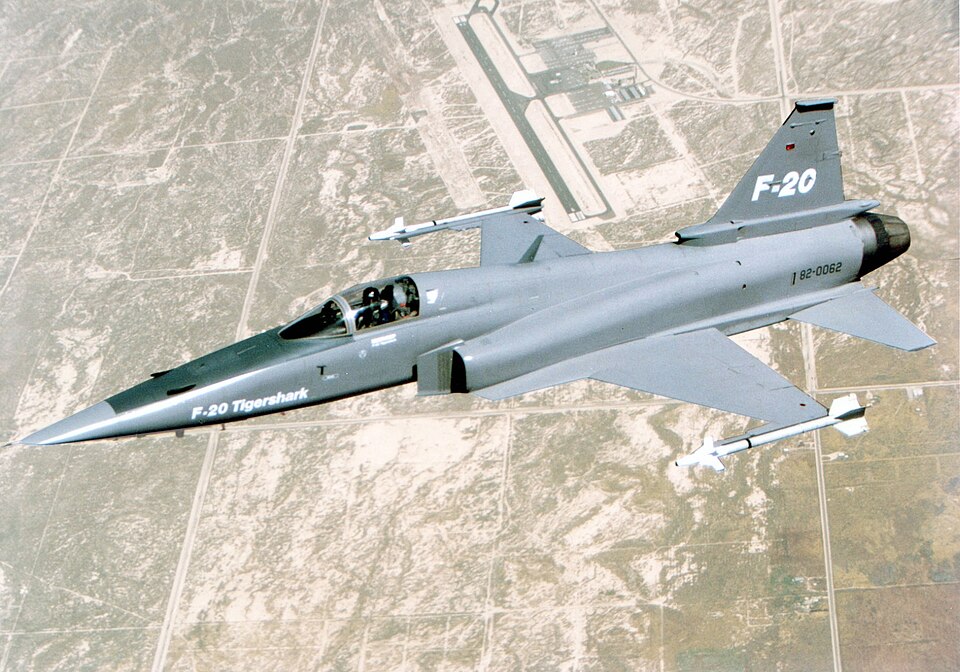
The Northrop F-20 Tigershark was a promising lightweight fighter that evolved from the successful F-5E Tiger II. Featuring a single powerful General Electric F404 turbofan engine, modern avionics, and beyond-visual-range missile capability, the F-20 was designed as a cost-effective alternative to the F-16 Fighting Falcon for export customers. Despite impressive performance, policy changes under the Reagan administration that allowed F-16 exports doomed the program, and it was cancelled in 1986 after three prototypes were built.
Design & Development
Northrop began developing the F-20 in 1975 under the designation F-5G, as part of the U.S. Department of Defense “FX” program. The Carter administration’s military export policy limited sales of frontline fighters to NATO allies, creating an opportunity for a capable but less sensitive fighter for other nations. Northrop redesigned the F-5E with a single General Electric F404 engine (replacing two J85s), an AN/APG-67 multimode radar, and modern avionics.
The result was dramatically improved: 60% more thrust, Mach 2.1 top speed, beyond-visual-range air-to-air capability with AIM-7 Sparrow missiles, and comprehensive air-to-ground modes. The first F-20 flew on 30 August 1982. However, when Ronald Reagan reversed Carter’s export restrictions, the F-20 suddenly had to compete directly against the F-16 — a battle it could not win despite lower costs.
Operational History
The F-20 never entered operational service. Three prototypes were built and one was partially completed before the program was abandoned in 1986. Tragically, two of the three prototypes were lost in accidents during demonstration flights — both attributed to G-induced loss of consciousness (G-LOC) by the pilots during aggressive maneuvers. The surviving prototype is on display at the California Science Center in Los Angeles.
Despite its failure to win orders, the F-20 influenced fighter design philosophy. Its AN/APG-67 radar became one of the most successful lightweight fighter radars in history, and the F404 engine went on to power the F/A-18 Hornet and many other aircraft.
Capabilities
- Maximum Speed: Mach 2.1 (2,124 km/h / 1,320 mph)
- Service Ceiling: 16,760 m (55,000 ft)
- Range: 1,850 km (1,150 miles)
- Engine: 1× General Electric F404-GE-100 turbofan, 17,000 lbf thrust
- Crew: 1
- Length: 14.17 m (46.5 ft)
- First Flight: 30 August 1982
- Units Built: 3 prototypes
Armament & Weapons
- Cannon: 2× 20 mm M39A2 cannons (450 rounds)
- Air-to-Air: AIM-9 Sidewinder and AIM-7 Sparrow missiles
- Air-to-Ground: AGM-65 Maverick missiles, Mk 80 series bombs, cluster munitions
- Hardpoints: 5 external hardpoints plus 2 wingtip rails
Video
Frequently Asked Questions
Why was the F-20 Tigershark cancelled?
The Reagan administration reversed Carter-era export restrictions, allowing the F-16 to be sold internationally. Without the policy protection, the F-20 could not compete against the established F-16 program.
How was the F-20 related to the F-5?
The F-20 was a direct evolution of the Northrop F-5E Tiger II, sharing the same basic airframe but with a much more powerful single engine, modern radar, and upgraded avionics.
How many F-20 Tigersharks were built?
Three complete F-20 prototypes were built, plus a fourth partially completed. Two were lost in accidents during demonstration flights.