✈️ Aircraft Specifications
| Designation | Mirage IVP |
| Manufacturer | Dassault Aviation |
| Country of Origin | France |
| First Flight | 1959 |
| Length | 23.49 m (77.1 ft) |
| Max Speed (Mach) | 2.20 |
| Max Speed (km/h) | 2,340 km/h |
| Service Ceiling | 20,000 m (65,620 ft) |
| Range | 4,000 km (2,484 mi) |
| Engine | 2x SNECMA Atar 9K afterburning turbojets |
| Crew | 2 |
| Status | Retired |
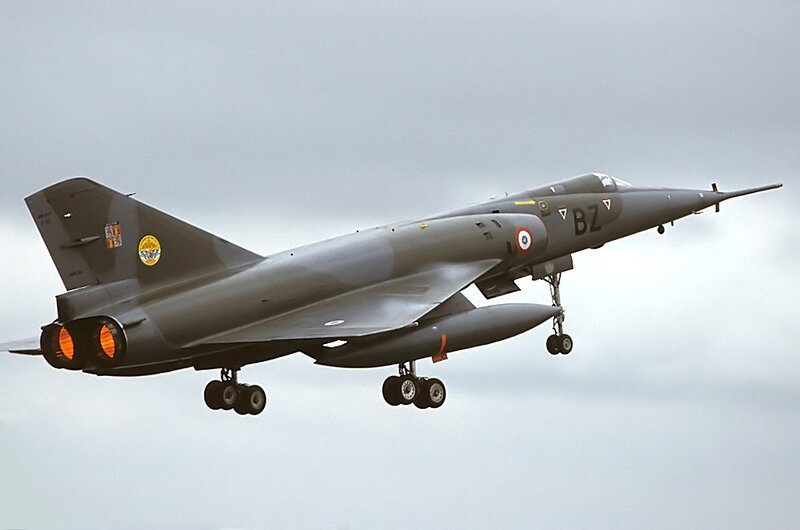
Overview
The Dassault Mirage IV is a French supersonic strategic bomber and deep-reconnaissance aircraft that served as the airborne pillar of France’s independent nuclear deterrent, the Force de Frappe. First flying on 17 June 1959, the Mirage IV was developed from the Dassault Mirage III fighter and entered service with the French Air Force in October 1964. A total of 62 production aircraft plus 4 prototypes were built. The Mirage IV set a world speed record of 1,822 km/h over a 1,000 km closed circuit in 1960, and served in the nuclear strike role until 1996 and as a reconnaissance platform until its final retirement in 2005.
Design & Development
Development began in the mid-1950s when France embarked on its military nuclear program and acknowledged that existing French aircraft were unsuitable for delivering nuclear weapons. In May 1956, the Guy Mollet government specified a supersonic bomber capable of carrying a 3-tonne nuclear bomb 2,000 km without aerial refueling — a surprisingly ambitious requirement for the era.
Dassault competed against Sud Aviation (proposing the Super Vautour) and Nord Aviation, winning the contract in April 1957 on the basis of lower cost and simpler development. The Mirage IV design drew upon the Mirage III fighter, though it was fundamentally a new aircraft with double the wing surface, two engines instead of one, twice the empty weight, and three times the internal fuel. The prototype Mirage IV 01 was 20 meters long with an 11-meter wingspan and approximately 25,000 kg maximum weight.
The prototype was built in 18 months at Dassault’s Saint-Cloud plant and performed its maiden flight on 17 June 1959. It was designed to explore the challenges of prolonged supersonic cruise — at the time, no aircraft had been built to cruise above Mach 1.8 for extended periods. The first production aircraft was completed in December 1963, incorporating advanced manufacturing techniques including machined and chem-milled planks, tapered sheets, titanium components, and integral fuel tanks throughout the airframe including the tailfin leading edge.
Operational History
The Mirage IV entered service on 1 October 1964 as a key component of France’s nuclear triad. Initially configured for high-altitude nuclear strike missions, the fleet was modified during the 1960s for low-altitude penetration profiles in response to increasingly capable Soviet air defense systems. This vulnerability also accelerated France’s development of alternative nuclear delivery platforms including land-based S2 missiles and submarine-launched ballistic missiles.
The fleet received significant upgrades throughout its service life. In the 1980s, Mirage IVP variants were modified to carry the ASMP (Air-Sol Moyenne Portée) nuclear stand-off missile, greatly improving survivability by eliminating the need to overfly the target. The Mirage IV also proved valuable in the strategic reconnaissance role, carrying specialized sensor pods. The type was retired from the nuclear strike mission in 1996 in favor of the Dassault Mirage 2000N, while the last reconnaissance-configured aircraft served until 2005. Despite investigations into export sales, including a proposed partnership with British Aircraft Corporation for RAF procurement, the Mirage IV was never adopted by any foreign operator.
Capabilities
- Maximum Speed: Mach 2.2 (2,340 km/h / 1,454 mph) at altitude
- Service Ceiling: 20,000 meters (65,600 feet)
- Range: 4,000 km (2,485 miles) with aerial refueling; 1,240 km combat radius without
- Engines: 2 × SNECMA Atar 9K afterburning turbojets, each producing 49.0 kN dry / 70.6 kN with afterburner
- Aerial Refueling: Equipped with fixed refueling probe for extending range on nuclear strike missions
- RATO Capability: 12 solid-fuel rockets for rocket-assisted takeoff to reduce runway requirements
- Strategic Reconnaissance: CT 52 reconnaissance pod for high-altitude photo intelligence
Armament & Weapons
- Nuclear Gravity Bomb: 1 × AN-22 (60 kt) or AN-52 (15 kt) free-fall nuclear bomb (recessed semi-externally)
- ASMP Missile: 1 × ASMP nuclear stand-off missile (300 kt warhead, 250 km range) on Mirage IVP variant
- Conventional Bombs: Up to 7,260 kg (16,000 lb) of conventional ordnance (though rarely configured for this role)
- No Guns: The Mirage IV carried no internal cannon armament — it was a pure bomber/reconnaissance platform
Video
Frequently Asked Questions
What role did the Mirage IV play in France’s nuclear deterrent?
The Mirage IV was the airborne component of France’s nuclear triad (the Force de Frappe), alongside land-based missiles and submarine-launched ballistic missiles. It was designed specifically to deliver French nuclear weapons against Soviet targets, maintaining France’s independent deterrent capability separate from NATO. Aircraft were kept on quick-reaction alert status, ready to launch within minutes of warning.
How was the Mirage IV related to the Mirage III fighter?
The Mirage IV was derived from the Mirage III but was a substantially different aircraft. It had double the wing area, two Atar engines instead of one, twice the empty weight, and three times the internal fuel. While the aerodynamic features were similar, the structure and layout were entirely new. The Mirage IV visually resembled an enlarged Mirage III but required a completely new airframe design.
Was the Mirage IV ever exported to other countries?
No, the Mirage IV was exclusively operated by the French Air Force. There were investigations into export sales during the 1960s, including a proposed partnership with British Aircraft Corporation to produce variants for the Royal Air Force, but these plans never materialized. The aircraft’s nuclear strike mission and its integration into France’s national defense strategy made export unlikely.
References & Sources
- Wikipedia – Dassault Mirage IV
- Gunston, Bill and Gilchrist, Peter. Jet Bombers: From the Messerschmitt Me 262 to the Stealth B-2. Osprey Publishing, 1993.
- Dassault Aviation Official Website