✈️ Aircraft Specifications
| Designation | Kfir C7 |
| Manufacturer | Israel Aircraft Industries |
| Country of Origin | Israel |
| First Flight | 1973 |
| Length | 15.65 m (51.3 ft) |
| Max Speed (Mach) | 2.3 |
| Max Speed (km/h) | 2,440 km/h |
| Service Ceiling | 17,680 m (58,008 ft) |
| Range | 768 km (477 mi) |
| Engine | General Electric J79-GE-J1E afterburning turbojet |
| Crew | 1 |
| Status | Active |
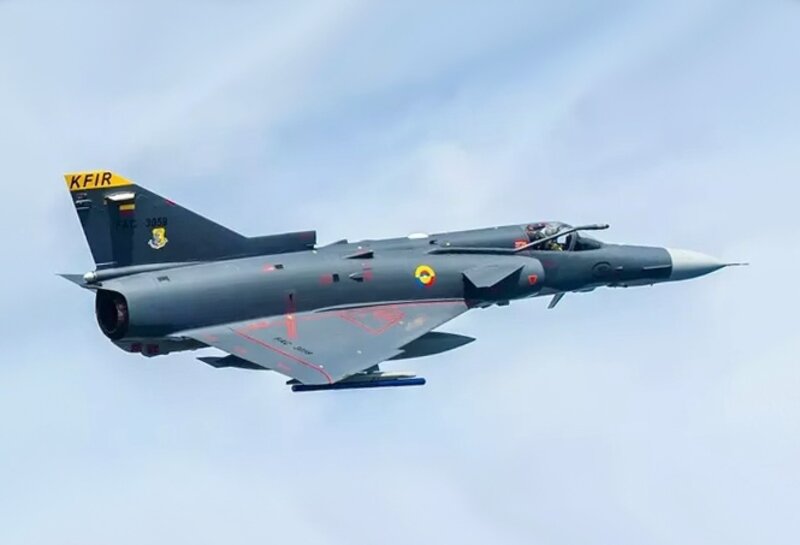
Overview
The IAI Kfir (Hebrew for “Lion Cub”) is an Israeli all-weather multirole combat aircraft developed by Israel Aircraft Industries. Based on the French Dassault Mirage 5 airframe with an Israeli-built General Electric J79 turbojet engine, the Kfir was born out of necessity following France’s 1967 arms embargo against Israel. Over 220 Kfirs were built, serving with the Israeli Air Force, Colombian Aerospace Force, Sri Lanka Air Force, and even the US Navy and Marine Corps as aggressor aircraft. The Kfir remains in active service with the Colombian Air Force as of the 2020s.
Design & Development
The Kfir’s origins trace back to Israel’s need to maintain air superiority after France embargoed arms sales in 1967. Israel had already produced the IAI Nesher, an unlicensed copy of the Mirage 5, using technical data obtained through espionage. The Kfir program aimed to create a more capable version by replacing the original French SNECMA Atar 09 engine with the significantly more powerful General Electric J79 turbojet — the same engine used in the F-4 Phantom II, which Israel was producing under license.
To accommodate the J79, the rear fuselage was shortened and widened, air intakes were enlarged, and a large cooling air inlet was added at the base of the vertical stabilizer. A two-seat Mirage IIIBJ fitted with the J79 first flew in September 1970. The improved prototype, designated Ra’am B (“Thunder B”), made its first flight in June 1973 with a revised cockpit, strengthened landing gear, and advanced Israeli avionics.
The Kfir C2 introduced fixed canards on the air intakes for improved maneuverability and additional hardpoints. Later variants including the Kfir C7 and C10 featured further aerodynamic refinements, upgraded avionics, and enhanced weapons capability. The aircraft demonstrated Israel’s growing capability to develop and produce advanced combat aircraft independently.
Operational History
The Kfir entered Israeli Air Force service in 1975, initially equipping the prestigious 101st “First Fighter” Squadron. However, its role as the primary air superiority fighter was short-lived, as F-15 Eagles arrived from the United States in 1976.
The Kfir’s first recorded combat action occurred on 9 November 1977 during an Israeli air strike in Lebanon. The only air-to-air victory claimed by a Kfir occurred on 27 June 1979, when a Kfir C2 shot down a Syrian MiG-21. The aircraft was also used extensively for ground attack missions during Israel’s operations in Lebanon.
The US Navy and Marine Corps leased 25 Kfirs designated F-21A for use as aggressor aircraft in dissimilar air combat training, exploiting the Kfir’s delta-wing flight characteristics to simulate Soviet fighters. Colombia acquired Kfirs in the 1980s and continues to operate upgraded versions for both air defense and counter-insurgency operations. Sri Lanka used Kfirs in combat operations against the Tamil Tigers during the civil war.
Capabilities
- Mach 2.3 top speed — High-speed performance at altitude thanks to the powerful J79 engine
- Delta-wing agility — Excellent instantaneous turn rate and high-alpha capability with canards
- Multirole flexibility — Effective in both air superiority and ground attack missions
- Indigenous production — Entirely Israeli-built, free from foreign arms embargoes
- 9 hardpoints — Capable of carrying a diverse range of weapons and stores
- All-weather capability — Elta EL/M-2001B radar for operations in all conditions
Armament & Weapons
- Internal guns: 2× DEFA 553 30mm cannons with 140 rounds per gun
- Air-to-air missiles: Rafael Python 3/4 infrared-guided AAMs, Shafrir 2 missiles
- Air-to-ground weapons: AGM-65 Maverick missiles, GBU-series laser-guided bombs, Mk 82/83/84 general-purpose bombs
- Rockets: LAU-series rocket pods
- External stores: Up to 6,085 kg on 9 hardpoints including 2 wingtip, 4 underwing, 2 intake-mounted, and 1 centerline
Video
Frequently Asked Questions
Why was the Kfir developed?
The Kfir was developed because France imposed an arms embargo on Israel in 1967, preventing delivery of 50 Mirage 5 aircraft that Israel had already paid for. Facing the threat of losing qualitative air superiority as Arab nations received advanced Soviet aircraft, Israel decided to develop its own fighter by combining the Mirage airframe (reverse-engineered through espionage) with the American GE J79 engine already available from F-4 Phantom production.
How does the Kfir compare to the Mirage 2000?
The Mirage 2000 is a generation ahead of the Kfir, featuring a fly-by-wire flight control system, more advanced RDI/RDM radar, and the SNECMA M53 turbofan engine. The Mirage 2000 has better sustained turn performance, more advanced avionics, and can carry a wider range of modern weapons. However, the Kfir C10 with its canards and upgraded avionics narrowed many of these gaps, and the Kfir’s J79 engine provided excellent thrust characteristics.
Is the Kfir still in service?
Yes, the Colombian Aerospace Force continues to operate upgraded Kfir C10/C12 variants as of the 2020s. These aircraft have been modernized with Elta EL/M-2032 AESA radar, advanced cockpit displays, and compatibility with modern precision-guided munitions. Colombia is expected to eventually replace the Kfir but has continued to extend its service life through upgrades.