✈️ Aircraft Specifications
| Designation | MiG-23MLD |
| Manufacturer | Mikoyan-Gurevich |
| Country of Origin | Soviet Union |
| First Flight | 1967 |
| Length | 16.7 m (54.8 ft) |
| Max Speed (Mach) | 2.35 |
| Max Speed (km/h) | 2,500 km/h |
| Service Ceiling | 18,500 m (60,699 ft) |
| Range | 1,150 km (714 mi) |
| Engine | Tumansky R-35-300 afterburning turbojet |
| Crew | 1 |
| Status | Retired |
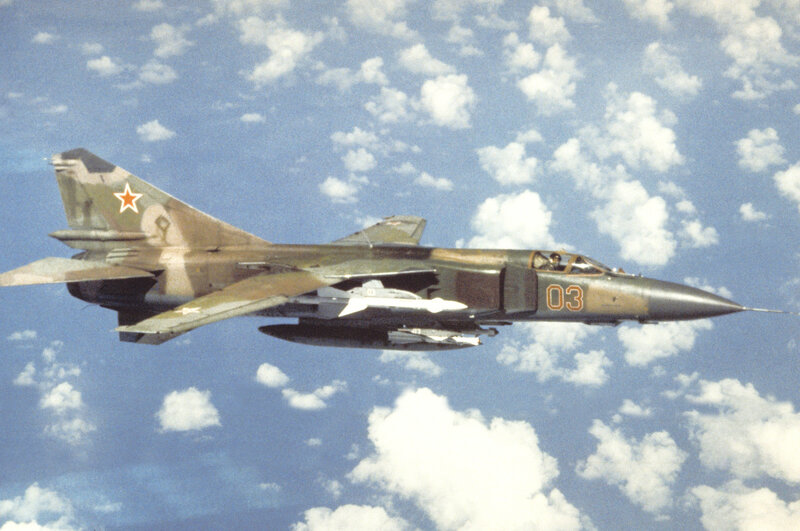
Overview
The Mikoyan-Gurevich MiG-23, NATO reporting name “Flogger,” is a Soviet variable-geometry fighter aircraft that became one of the most widely produced swing-wing aircraft in aviation history. With over 5,000 units built between 1967 and 1985, the MiG-23 served as the backbone of Soviet tactical air power during the Cold War and was exported to numerous allied nations around the world. The aircraft represented a significant leap over its predecessor, the MiG-21, offering improved range, more capable avionics, and beyond-visual-range missile capability for the first time in a Soviet fighter.
Design & Development
Development of the MiG-23 began in the early 1960s as the Soviet Air Force sought a replacement for the MiG-21 with better range, avionics, and weapons capability. The Mikoyan design bureau explored two approaches: lift jets for short takeoff and variable-geometry wings. The lift jet concept, tested in the MiG-23PD prototype, proved impractical as the jets became dead weight once airborne.
The variable-geometry wing design, designated “23-11,” featured wings that could sweep to 16°, 45°, and 72° positions. This prototype first flew on 10 June 1967, piloted by the legendary test pilot Aleksandr Fedotov. The swing-wing configuration provided excellent low-speed handling for takeoff and landing while allowing high-speed supersonic flight. Series production was ordered in December 1967, with the first production MiG-23S flying on 21 May 1969.
The MiG-23 was influenced by Western designs like the F-111 and F-4 Phantom II, but Soviet engineers kept the aircraft significantly lighter as a single-engine design, preserving its dogfighting agility. The aircraft underwent continuous development, with the MiG-23M introducing the Sapfir-23 radar with look-down/shoot-down capability, and the final MiG-23MLD variant offering greatly improved maneuverability and avionics.
Operational History
The MiG-23 entered Soviet Air Force service in 1970 and quickly became one of the most important fighters in the Warsaw Pact arsenal. The aircraft was deployed extensively across Eastern Europe, serving as a frontline interceptor and fighter-bomber throughout the Cold War era.
In combat, the MiG-23 saw action in numerous conflicts across the Middle East and Africa. Syrian MiG-23s engaged Israeli aircraft during the 1982 Lebanon War, while Libyan Floggers clashed with US Navy F-14 Tomcats over the Gulf of Sidra in 1989. Iraqi MiG-23s were used extensively during the Iran-Iraq War and the Gulf War. The aircraft also saw combat service in Angola, Ethiopia, and other African conflicts.
The ground-attack variant, the MiG-27, proved to be an effective strike platform and saw extensive use with the Indian Air Force. While the MiG-23 has been largely replaced by more modern fighters like the MiG-29 and Su-27 in most air forces, a small number remain in limited service with a few export operators as of the 2020s.
Capabilities
- Variable-geometry wings — Sweep angles of 16°, 45°, and 72° for optimized performance across all flight regimes
- Look-down/shoot-down radar — Sapfir-23 radar system enabling detection of low-flying targets against ground clutter
- Beyond-visual-range combat — First Soviet fighter capable of firing BVR missiles with the R-23/R-24 series
- Mach 2.35 top speed — High-altitude supersonic performance at up to 2,500 km/h
- Multi-role capability — Fighter and ground-attack variants for versatile mission profiles
- Short-field performance — Variable wings enabling operations from shorter, rougher runways
Armament & Weapons
- Internal gun: 1× GSh-23L 23mm twin-barrel autocannon with 200 rounds
- Air-to-air missiles: R-23/R-24 (AA-7 Apex) medium-range, R-60 (AA-8 Aphid) short-range infrared, R-73 (AA-11 Archer) on late variants
- Air-to-ground missiles: Kh-23 (AS-7 Kerry) radio-guided missiles
- Rockets: UB-16 and UB-32 rocket pods with S-5 rockets, S-24 heavy rockets
- Bombs: Up to 2,000 kg of various free-fall and guided munitions on multiple hardpoints
Video
Frequently Asked Questions
Why does the MiG-23 have variable-sweep wings?
The variable-sweep wings allow the MiG-23 to optimize its aerodynamic performance for different flight conditions. Fully swept forward (16°), the wings provide maximum lift for takeoff, landing, and low-speed maneuvering. At 45°, they offer a balanced configuration for cruising and combat. Fully swept back (72°), the wings minimize drag for high-speed supersonic flight and low-altitude penetration missions.
How does the MiG-23 compare to the F-14 Tomcat?
While both aircraft feature variable-sweep wings, they differ significantly in design philosophy. The F-14 is a larger, twin-engine naval fighter designed for fleet air defense with the powerful AWG-9 radar and AIM-54 Phoenix long-range missiles. The MiG-23 is a lighter, single-engine tactical fighter designed for shorter-range air superiority and ground attack. The F-14 generally had superior radar and weapons range, while the MiG-23 was simpler, cheaper, and easier to maintain.
Is the MiG-23 still in service?
As of the 2020s, the MiG-23 remains in very limited service with a handful of air forces, though most operators have retired the type. The aircraft has been largely replaced by more modern fourth-generation fighters. Some nations in Africa and the Middle East continued to operate small numbers into the 2010s, though serviceability has steadily declined due to age and spare parts availability.
How many MiG-23s were built?
Over 5,047 MiG-23s were built between 1967 and 1985, making it the most produced variable-sweep wing aircraft in history. The type was manufactured primarily at the Znamya Truda factory in Moscow and was exported to over 30 countries worldwide.